Download
1 / 6
60 likes | 182 Views
This review covers essential topics for Exam 2 in data structures, focusing on Splay Trees, K-D Trees, RB Trees, Priority Queues, Binary Heaps, and B-Trees. For each structure, we discuss basic concepts, operations, flow of simple example problems, and theorem proofs. Key performance metrics such as amortized time, advantages, limitations, and comparisons are analyzed. This guide prepares you for understanding insertion, deletion, balancing, and specific operational efficiencies in these crucial data structures.

E N D
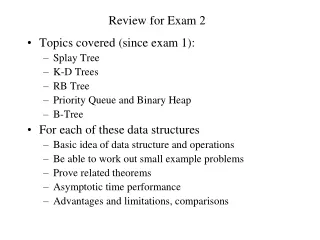
Review for Exam 2 • Topics covered (since exam 1): • Splay Tree • K-D Trees • RB Tree • Priority Queue and Binary Heap • B-Tree • For each of these data structures • Basic idea of data structure and operations • Be able to work out small example problems • Prove related theorems • Asymptotic time performance • Advantages and limitations, comparisons
Review for Exam 2 • Splay tree • Definition (a special BST: balanced in some sense) • Rationale for splaying: amortized performance • Splay operation (bottom up) • Rotation • without grandparent • with grandparent: zig-zag and zig-zig • When to splay (after each operation) • What to splay with find/insert/delete operations • Amortized time performance analysis: what does O(m log n) mean?
Review for Exam 2 • K-D Trees • What K-D trees are used for • Multiple keys • Range queries • How K-D trees differ from the ordinary BST • levels • Be able to do insert and range query/print • Limitations • Hard to do deletion • Difficult to balance
Review for Exam 2 • RB tree • Definition: a BST satisfying 5 conditions • Every node is either red or black. • Root is black • Each NULL pointer is considered to be a black node • If a node is red, then both of its children are black. • Every path from a node to a NULL contains the same number of black nodes. • Theorems leading to O(log n) worst case time performance • Black height • min and max # of nodes a RB tree with bh=k can have • Bottom-up insertion and deletion • When and what to rotate and recolor
Review for Exam 2 • PQ and binary heap • Binary heap • Definition: CBT with a partial order (heap order) • Why it is good for PQ • Heap operations (with array implemention) • findMin, deleteMin, insert • percolateUp (for insertion), percolateDown (for deletion) • Heap construction (heapify starting from the middle), • Heapsort • Time performance of these operations • Leftist tree and leftist heap • Why we need this? • Definition (npl: null path length) • Meld operations and applications • insert, deletMin, heap construction
Review for Exam 2 B-Trees • What is a B-tree • Special M-way search tree (what is a M-way tree) • Internal and external nodes • M and L (half full principle), especial requirement for root • Why need B-tree • Useful/advantageous only when external storage accesses required and why? • Height O(logM N), performances for find/insert/remove • B-tree operations • search • insert (only insert to nonempty leaf, split, split propagation) • Remove (borrow, merge, merge propagation, update ancestors’ keys ) • B-tree design • determining M and L based on the size of key, data element, and disk block