Neurons and synapses
Neurons and synapses. IB2 Biology Jin Young Huh. Organization of the Nervous System. Central nervous system (CNS) Brain Spinal cord Peripheral nerves. Sensory and motor neurons. Sensory neurons receptors (sensory cells) CNS Motor neurons CNS effectors (muscle and gland cells)

Neurons and synapses
E N D
Presentation Transcript
Neurons and synapses IB2 Biology Jin Young Huh
Organization of the Nervous System • Central nervous system (CNS) • Brain • Spinal cord • Peripheral nerves
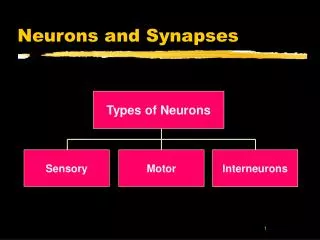
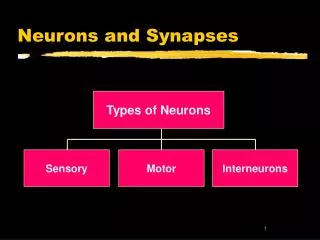
Sensory and motor neurons • Sensory neurons • receptors (sensory cells) • CNS • Motor neurons • CNS • effectors (muscle and gland cells) • Relay neurons • between neurons
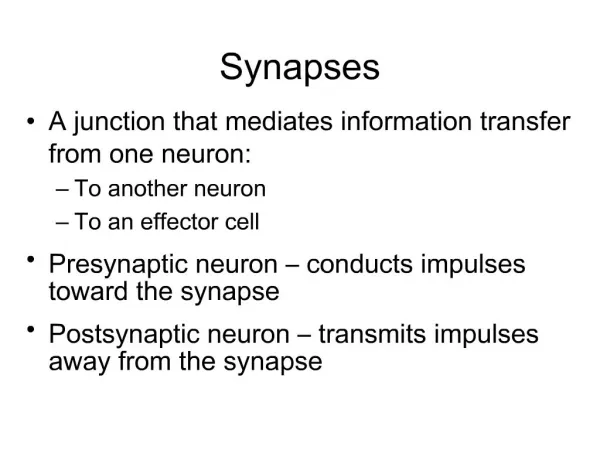
Synapses • Junction between two neurons • Neurotransmitters • Pre-synaptic neuron • Post-synaptic neuron
Stages in synaptic transmission http://www.youtube.com/watch?v=z3F5dfmQ3hk http://www.youtube.com/watch?v=9nUY6o-LCWY
Sources • Study Guide • Academico • http://academic.uprm.edu/~ephoebus/id81.htm • Wikispace • http://biologyataglance.wikispaces.com/Controlling+life
Central nervous system (CNS): part of nervous system that consists of the brain and spinal cord, regulating the body’s responses to external and internal stimuli Neurons: cells in the central nervous system that can carry messages at high speed in the form of electrical impulses. Spinal cord: a long, thin, tubular bundle of nervous tissue and support cells that extends from the brain Peripheral nerves: nerves that connect all parts of the body to the central nervous sytem Sensory neurons: neurons that carry nerve impulses from sensory cells (receptors) to the CNS Motor neurons: neurons that carry impulses from the CNS to effectors (muscle and gland cells) Relay neurons: neurons that carry impulses within the CNS, from one neuron to another Axon: a long, slender projection of a neuron that conducts electrical impulses away from the neuron’s cell body (soma) Dendrites: the branched projections of a neuron that act to conduct the electrochemical stimulation received from other neural cells to soma Neurotransmitters: endogenous chemicals which transmit signals from a neuron to a target cell across a synapse Depolarization: a change in cell’s membrane potential, making it more positive, or less negative Vesicles: a small membrane-enclosed sac that can store or transport susbstances Vocabulary