Understanding the Cell Cycle: From Cell Division to Life's Building Blocks
Explore the fascinating world of cells and their life cycle known as the cell cycle. All living things are made up of cells, which are the fundamental units of life. The cell theory states that cells come from other cells, highlighting their importance in growth, repair, and maintenance of living organisms. Delve into the two main phases of the cell cycle: interphase, where DNA is copied, and mitosis, where the cell divides into two new nuclei. Learn about the steps of mitosis—prophase, metaphase, anaphase, and telophase—and the incredible number of blood cells our bodies produce daily.

Understanding the Cell Cycle: From Cell Division to Life's Building Blocks
E N D
Presentation Transcript
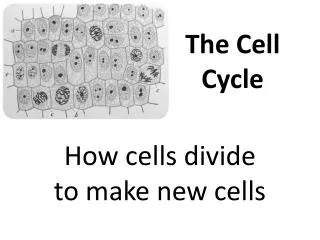
The Cell Theory • All living things are made of cells • Cells are the basic organizational unit of life. • Cells must come from other cells.
Fun facts… • The human body must make an average of 610 billion blood cells per day. • 200,000,000,000 red cells per day • 10,000,000,000 white cells per day • 400,000,000,000 platelets per day • The human body is made of about 100 trillion cells.
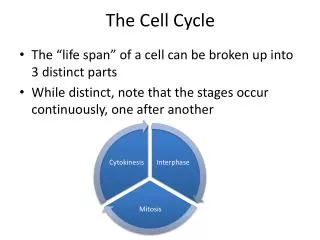
The Cell Cycle • The cell has a life cycle called the cell cycle.
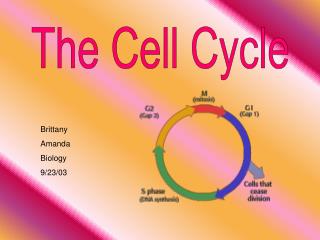
The Cell Cycle • The cell cycle can simply be divided into 2 parts • Interphase • Mitosis
The Cell Cycle Interphase Mitosis
Interphase • Cells spend the majority of their time in interphase. • DNA is copied during this time
Copying the DNA Chromatids Centromere holds the copied chromosome together Chromatin is un-wound DNA Chromosome that has not been copied. Copied Chromosome
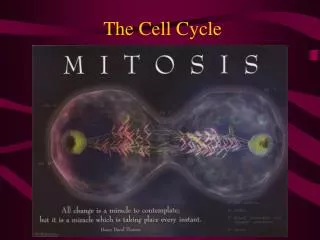
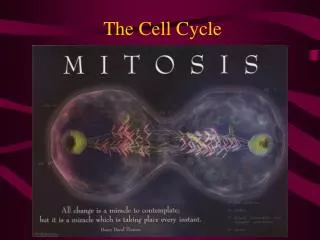
Mitosis • Mitosis is when the nucleus of a cell divides into 2 new nuclei
So, what are the steps to mitosis? • Prophase • Metaphase • Anaphase • Telophase • Easy way to remember: P-MAT
Prophase • Chromatids are visible in nucleus. • Nuclear membrane dissolves • Spindle fibers stretch towards the nucleus Chromatids Centromere holds the copied chromosome together Copied Chromosome Chromosome that has not been copied.
Metaphase • Chromatid pairs line up along the center of the cell.
Anaphase • Chromosomes separate.
Telophase • Cytoplasm separates • New nuclei form in each cell
When does Mitosis happen? • When a cell needs to be replaced: • When an organism is growing • After an injury where cells are lost • To maintain a living organism (once it is adult size)
Why does Mitosis happen? • Because there needs to be a way to make more cells