Natural Hazards
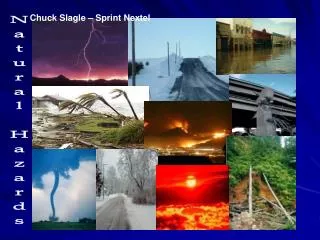
Natural hazards are linked to the geographic characteristics of an area, influencing safety and construction. Floods occur when water spills onto dry land, either slowly or suddenly as flash floods. Tsunamis, generated by underwater disturbances, threaten coastal regions. Hurricanes, forming storms with winds over 75 mph, cause significant damage. Tornadoes, spinning columns of air with winds up to 300 mph, affect "Tornado Alley." Earthquakes and volcanoes bring rapid destruction, while landslides can devastate landscapes. Understanding these hazards is essential for effective planning and safety measures.

Natural Hazards
E N D
Presentation Transcript
Questions • What are the natural hazards that come with geography of an area? • Where is the best place to build your stronghold?
Flood • Def-when water overflows onto normally dry land • Can occur slowly or quickly • Flash flood-floods that occur quickly • Can be a wall of water carrying rocks, etc. • Anywhere, esp. low-lying areas, near water, downstream from a dam.
Tsunami (Tidal Wave) • Def-series of waves created by underwater disturbance • E.g: earthquake, landslide, volcanic eruption, meteroite • Coastal areas prone • Dangers: drowning, flooding, water contamination, fires • Safest place to be, in deep ocean
Hurricane • Def-huge storm with minimal winds of 75 mph • Causes damage from flying trash, storm surges, flooding, mudslides, etc • Atlantic Coast, Gulf of Mexico, U.S. prone
Tornado • Def-tube of violent spinning air that touches ground • Winds up to 300 mph • Occur near edge of thunderstorms • “Tornado Alley”-Midwest U.S.
Earthquakes • Def-sudden, rapid shaking of earth • Caused by breaking and shifting of earth’s crust • Can cause tsunami, property damage • West Coast U.S. prone, some in Central U.S.
Volcano • Def-mountain that spews out molten rock • Lava flows destroy anything in its path • Volcanic ash can destroy forests, kill people due to quick spread
Landslide • Def-masses of rock, earth, debris (trash) move down a slope • Can move large bolders, cars, destroy buildings, roads