Download
1 / 20
210 likes | 365 Views
This article explores the 1866 eruption of T. Pyx, a classical nova, and its implications for recurrent novae (RNe). Ejection data from various eruptions indicates that many RNe white dwarfs lose mass rather than gain it, suggesting they are unlikely to evolve into Type Ia supernovae. We analyze measurements from several eruptions, noting that recurrent novae are predominately neon novae, potentially challenging traditional models of supernova progenitors. Observational findings emphasize the lack of red giant companions in supernova remnants, further refining our understanding of nova dynamics.

E N D
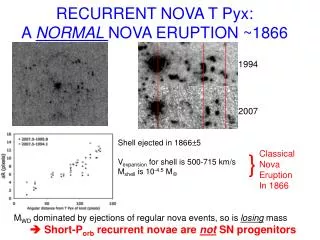
19942007 RECURRENT NOVA T Pyx:A NORMAL NOVA ERUPTION ~1866 Shell ejected in 1866±5Vexpansion for shell is 500-715 km/sMshell is 10-4.5 M ClassicalNova Eruption In 1866 } MWDdominated by ejections of regular nova events, so is losing mass Short-Porb recurrent novae are not SN progenitors
GET Mejecta FROM PERIOD CHANGE ACROSS ERUPTIONS Mejecta = (MWD/A)*(P/P)
U SCO 2010 ERUPTION:LARGE PERIOD CHANGE • P = (27.6 ± 1.4) x 10-6 days • Mejecta= (27.7 ± 1.4) x 10-6M • T = 10.9 years, M = (0.1±0.05) x 10-6 M/yr
T PYX 2011 ERUPTION:LARGE PERIOD CHANGE • P = (4.0 ± 0.3) x 10-6 days • Mejecta= (58.8 ± 5.5) x 10-6M • T = 44.3 years, M = (0.1±0.05) x 10-6 M/yr
CI AQL 2000 ERUPTION:SUBSTANTIAL PERIOD CHANGE • P = (1.5 ± 1.0) x 10-6 days • Mejecta= (2.9 ± 2.0) x 10-6M • T = 24 years, M = (0.1±0.05) x 10-6 M/yr
RECURRENT NOVA WHITE DWARFS ARE EJECTING MORE MASS THAN THEY ARE ACCRETING • RNe WDs losing mass • RNe will not become Type Ia supernova
HALF OF THE RECURRENT NOVAE ARE NEON NOVAE Mason et al. 2012, A&A A neon nova cannot have its WD gaining mass, because it is dredging up new material each eruption. A neon nova must have an underlying ONeMg WD and cannot become a supernova, because it is not the required CO white dwarf. Half-or-more of RN will not become supernovae
SNR 0509-67.5 FINAL 3-s ERROR CIRCLE IS EMPTY OF POINT SOURCES TO V=26.9 3-s error circle: Measurement Error + Orbital Velocity + Kicks
THE UTTER LACK OF ANY EX-COMPANION RULES OUT ALL MODELS EXCEPT THE DOUBLE DEGENERATE Schaefer & Pagnotta 2012, Nature Limiting mag of V=26.9 MV=8.4 (K9 on main sequence) ✖ ✖ ✖ ✖
TWO MORE LMC TYPE Ia SN REMNANTS HAVE NO RED GIANT or SUBGIANT EX-COMPANIONS Edwards, Pagnotta, & Schaefer 2012, ApJLett SNR 0519-69.0 SNR 0505-67.9 SN1006 HAS NO RED GIANT EX-COMPANION Gonzalez-Hernandez et al. 2012, Nature
SN 2011fe HAS NO RED GIANT COMPANION Li et al. 2011, Nature Lack of any counterpart on pre-eruption HST images proves the companion cannot be a luminous red giant or a luminous Helium star. Li et al. (2011) (arXiv)
NO ‘KASEN EFFECT’ IN 235 SUPERNOVAE MEANS NO RED GIANT COMPANION Kasen 2010, ApJ
NO EMISSION FROM EJECTA/WIND COLLISION MEANS NO RED GIANT COMPANION BUT: A few SNe(PTF11kx, SN2002ic, & SN2005gj) show variable narrow emission lines that are a clear hall mark of interaction with a circumstellar medium 0.1% - 1% of progenitors are Symbiotic Stars
SCORECARD FOR RED GIANT COMPANIONS: _____ ___ 145 0
GENERALIZING – IF ONE CLASS DOMINATEs: SNR0509 center is empty No Red Giants No Red Giants SNR0509 center is empty No Hi-L stars Neon WDs, Mejecta too high No Kasen effect
GENERALIZING – IF TWO CLASSES DOMINATE: SNR0509 center is empty No Red Giants No Red Giants SNR0509 center is empty No Hi-L stars Neon WDs, Mejecta too high No Kasen effect No Red Giants No Red Giants No Hi-L stars Different from first class No Kasen effect Neon WDs, Mejecta too high
CONCLUSIONS: Two RNe have Mejecta>>MDT Half of the RNe are neon nova T Pyx had a classical nova eruption in 1866 and is fast exiting the RN phase SNR0509-67.5 has an empty central region to MV= +8.4 Out of a sample of 145 SNe, 0 have red giant companions (with similar but weaker restrictions for subgiant companions) SYMBIOTIC DOUBLE DEGENERATE or SYMBIOTIC SUPERSOFT? DOUBLE DEGENERATE