Understanding Ecosystems: Relationships, Niche, and Population Dynamics
260 likes | 378 Views
This overview explores the intricate relationships within ecosystems, emphasizing biotic and abiotic factors. It details the niche concept, highlighting the specific roles of various warblers in a spruce tree community. The principles of competition, predation, and symbiosis, including mutualism, commensalism, and parasitism, are examined. The document also covers ecological succession, characteristics of populations, and growth rates, differentiating between exponential and logistic growth. Key factors influencing populations are discussed, including density-related and independent limiting factors.


Understanding Ecosystems: Relationships, Niche, and Population Dynamics
E N D
Presentation Transcript
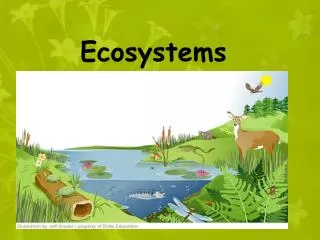
Ecosystems Relationships and Populations
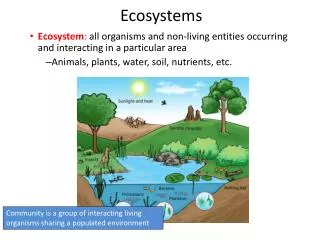
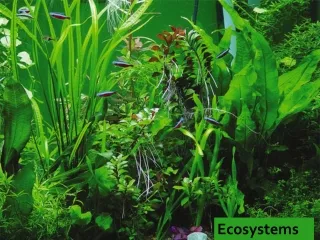
Biotic and Abiotic Factors (Living and Non-Living) Abiotic Factors Biotic Factors ECOSYSTEM
Niche • Part of the environment that an organism uses • ROLE + HABITAT
Warbler Niche Cape May Warbler Feeds at the tips of branches near the top of the tree Bay-Breasted Warbler Feeds in the middle part of the tree Yellow-Rumped Warbler Feeds in the lower part of the tree and at the bases of the middle branches Spruce tree
Competition individuals or species trying to use the same limited resource
Competition • competitive exclusion principle – 2 species cannot occupy the same niche in the same habitat at the same time
Predator/Prey - +/- -the predator catches the prey - One organism captures and kills another http://www.wallpaperbase.com/wallpapers/animals/tigers/tiger_6.jpg http://inspectorgadget.files.wordpress.com/2007/12/tiger.jpg
Symbiosis Two species living closely together http://sugarmtnfarm.com/blog/uploaded_images/ClownInBubbleAnemone200511-780236.jpg
Symbiosis • Mutualism - +/+ • both species benefit
Symbiosis b. commensalism - +/0 – one benefits, the other is not helped nor harmed Example – a bird’s nest in a tree OR barnacles on whales
Symbiosis • c. Parasitism - +/- • one species benefits (parasite), one is harmed (host)
Ecological Succession – natural progression of an environment 1. primary succession – starting where there is no soil http://www.v-liz.com/galapagos/isabela/puntam~1/lavacac-.jpg
2. secondary succession – where there was a community, but it has been removed
Climax Community – last stage of succession, ecosystem has reached equilibrium
Important characteristics of populations • geographic distribution – • the area inhabited by a population • density – • number of individuals per unit area • growth rate – • depends on birth rate and death rate
density – • number of individuals per unit area high density low density
Exponential growth • ideal conditions • unlimited resources
Growth rate of bacteria • some bacteria can divide every 20 minutes • first 20 minutes – there will be two bacteria • in one hour - there will be 64 bacteria • in one day – there would be: • 4,720, 000,000,000,000,000,000 • or 4.72 x 10²¹
Logistic growth • as resources become limited • growth rate slows or stops • carrying capacity is reached • Carrying Capacity – maximum population size an area can support
Logistic Growth – S shaped curve, levels off at the Carrying Capacity Carrying capacity Number of Yeast Cells Time (hours)
Limiting factors • nutrient • space • carbon dioxide level • density-dependent – competition, predation, disease, parasitism • density-independent – weather, human activities, seasonal cycles
Age-structure diagram • shows number or percentage at each age