Download
1 / 36
360 likes | 500 Views
The RICH detector is a key component of the AMS project, aimed at studying cosmic ray particles to detect primordial antimatter and dark matter. Developed by an international collaboration including institutions in Bologna, Grenoble, and Maryland, the RICH detector uses cutting-edge technologies for particle identification and discrimination. The project received NASA/DOE approval in 1994 and was launched on the ISS in 2005. This paper outlines the design, construction, and functionality of the RICH detector, including its role in high-energy gamma-ray astronomy and cosmic ray studies.

E N D
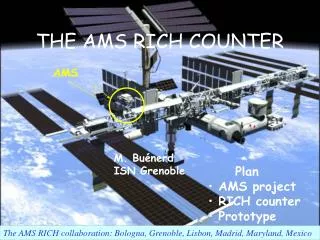
THE AMS RICH COUNTER AMS M. Buénerd ISN Grenoble • Plan • AMS project • RICH counter • Prototype RICH2002@Pylos The AMS RICH collaboration: Bologna, Grenoble, Lisbon, Madrid, Maryland, Mexico
The AMS collaboration UNAM S.C.C. TING (MIT), PI RICH2002@Pylos
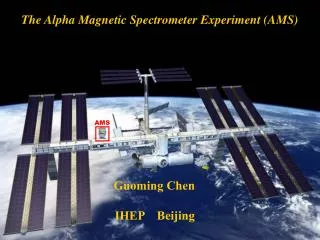
AMS Scientific Program on the ISS • High statistics study of Cosmic Ray particles: • Allowing sensitive search for : • Primordial antimatter(primary goal of the project): • Dark matter (neutralino annihilation): • High energy gamma ray astronomy RICH2002@Pylos
The AMS & RICH calendar • 1994 Approval of the project by NASA/DOE • June 1998:Instrumental flight on the space shuttle DISCOVERY, 10 days • 1999-2004:AMS02 design & construction for ISS phase: SC magnet+ECAL+RICH+TRD • 2005: AMS02 launch & installation on the International Space Station • ~2005-2008: Data taking RICH2002@Pylos
TRDe+/p & e-/p Discrim P<300GeV/c - THE AMS SPECTROMETER TOF Hodoscopes(TOF & dE/dX) Cryostat & SC Magnet(B = 1T) VETO Tracker(P & dE/dX measurement) RICH(particle ID A<~25, Z<~25) EMC(ID em particles) RICH2002@Pylos
Rôle in AMS: • Ion identification (A & Z) • p/e- and p/e+ discrimination • Albedo particle rejection _ THE AMS RICH COUNTER RICH2002@Pylos
RICH design history • 1997-99 : - First simulation works to evaluate the possible performances: see NIM A454(2000)476 • - Study prototype, construction and operation(T.Thuillier et al., NIM A, in press, astro-ph/0201051) • 2000-2002 : - (Iterations to) final design • - Second generation prototype RICH2002@Pylos
è • Proximity focusing counter, photomultipliers • 2 radiators for a maximum momentum range for particle identification (~1-13 GeV/c/nucleon) Imaging technique & main design features • Design drastically constrained by: • Volume • Weight (currently ~190kg) • Power consumption • Long term reliability of components • Magnetic field in the photodetector region RICH2002@Pylos
Simulation of 10Be detection 10Be 9Be 7Be A.Bouchet et al,Nucl.Phys A668(2000) The isotopic abundance ratio 10Be/ 9Be depends on: - Time of confinement of CRs in galaxy - ISM density and galactic halo size 6 weeks counting è ~ 200000 events ! RICH2002@Pylos
The RICH architecture ECAL hole Radiator(s) Conical mirror Photodetectors RICH2002@Pylos
Rich assembly (exploded view) Mirror made inUSA (~13kg) Resp. Bologna NaF radiator ? AEROGEL radiatorplane. Produced in Japan, Characterized in Mexico Support structure Madrid Photon drift space Photodetector plane 680 PMTs ~104 pixels of photosensors(Japan) Mech Designfrom GavazziCo, Italy Structure Assembly (Bologna/Gavazzi) LOWER PANEL RICH2002@Pylos
Shielding Grid Structure Courtesy G. Sardo, Gavazzi Space Co End beam Th. = 0.8 mm Th. = 1.0 mmTh. = 1.2 mm Support beam Bottom skin RICH2002@Pylos
Photomultipliers • Requirements: • Must stand high magnetic field (>~100 G) • Multianode ~5x5mm pixels è Hamamatsu R7600-M16 RICH2002@Pylos
RICH photodetector and front end electronics assembly PMT HamamatsuR7600-M1616 anodes~4.5x4.5mm2 PC Boards, RO and HVD Flex(ible) support Integrated Circuit: AustriaMikroSystem Technology RICH2002@Pylos
Front end electronics Principle: Spectroscopy type charge preamplifier, 16 multiplexed channels, 2 gain (x1 & x5) modes RICH2002@Pylos
Prototype of detector module (16) Light guides (16 pixel) PMT Readout electronics Housing (half) shell RICH2002@Pylos
RICH prototype (2nd generation) RICH2002@Pylos
Prototype = ~½ module of final counter Rich detector plane Prototype a96 PMTs, 1536 pixels RICH2002@Pylos
Prototype experimental set-up (Cosmic ray configuration) Cosmic m Scintillators Trigger electronics and MWPC readout MWPCs Vacuum chamber Radiator PMT Matrix AMS Proto DAQ 3 Radiators tested aerogels 1.03, 1.05, NaF RICH2002@Pylos
Detection plane PMT array before light guide Installation Light guides installed RICH2002@Pylos
Back view of proto 2 Readout lines(9 PMTs/line) RICH2002@Pylos
Top view of the set-up LED PMT matrix Scintillators RO electronics MWPC tracker Vacuum chamber Chamber lid RICH2002@Pylos
PC2 RICH prototype DAQ setup Tracker : MWPCs + delay line RO [CAMAC] Trigger : scintillators + PMTs [CAMAC] P S VME BUS SUN Station RICH2002@Pylos L. Gallin-Martel ISN Grenoble, AMS - CERN October 19th 2001
Readout and DAQ • Each board (33PMTs): • 1 DSP controlled FPGA + memory buffer • 3 DAQ modes controlled by DSP: • calibration: pedestal calibrated and tabulated • RAW: 2 gains and all channels stored • REDUCED : gain mode selection and channel reduction RICH2002@Pylos
Particle hit on LG+PMT Prototype performances in Cosmic Ray tests Example of (muon) event measured in CR tests RICH2002@Pylos
Velocity resolution Only a resolution estimate since no measurement of the incident momentum of particles. Reconstructed b spectrum Aerogel radiator n=1.03 ° Data • Resolution per hit: • Measured: 3.2 10-3 • MC : 2.5 10-3 MC simulation è (Db/b)event~ 10-3 (Z=1) Contribution from mwpc tracker being reduced RICH2002@Pylos
Next steps • Technical tests : Vacuum, thermal, vibrations • Ion beam test at CERN on next october • Detector modules assembly will start on next January 2003. • - Counter assembly finalized by end of 2003. RICH2002@Pylos
Summary & Conclusion • The AMS RICH is fully designed • End-to-end tests of the prototypes have been performed successfully. • Radiators (aerogels 1.03/05, NaF), PMTs, Light guides, FE and RO electronics, processing algorithms, provide the expected results (See talk by F. Barao). • The forthcoming in-beam tests with ions at CERN on october will complete the tests. • è The AMS RICH is on the tracks…. for flying on the ISS. RICH2002@Pylos
Cosmic Ray studies with the RICH What the RICH will do: • Reject Albedo particles (prototype inefficiency < 10-3 ) • Discriminate e+/p & e-/pbar (p < ~12 GeV/c) • Identify nuclei or elements: Assuming DP/P~1% RICH2002@Pylos
<G(x5)> = 69<s/Q> ~ 0.47 <sped> ~ 4.3 Electronics settings PMTs grouped by 11 (10) / flex RICH2002@Pylos
Raw data vs simulation RICH2002@Pylos
Noise 3 ms delayed trigger Aerogel 1.03 run El noise ~ 8 10-5 hit/chan DC ~ 4 10-5 hit/chan RICH2002@Pylos
Proto_1 Z separation Z separation obtainedwith proto 1 at GSI with 1GeV/n 12C beam RICH2002@Pylos
Proto_1 b(z) resolution bresolution obtainedwith proto 1 at GSI with 1GeV/n 12C beam. RICH2002@Pylos
Field map at PMTs RICH2002@Pylos
What ion mass and charge ID range with the RICH ? • From simulation results: • Mass range A< ~30 • Charge range Z< ~25 • Momentum range P< ~15 GeV/c Assuming DP/P~1% The upper bounds quoted for A and Z are asymptotic limits RICH2002@Pylos