Photosynthesis
Mader: Biology, 9th Ed.. Photosynthetic Organisms. Photosynthesis Process that captures solar energyTransforms solar energy into the chemical energyChemical energy is stored in the form of a carbohydrateAll organisms use organic molecules produced by photosynthesizers as a source of chemical energy.

Photosynthesis
E N D
Presentation Transcript
1. Photosynthesis Chapter 7
2. Mader: Biology, 9th Ed. Photosynthetic Organisms Photosynthesis
Process that captures solar energy
Transforms solar energy into the chemical energy
Chemical energy is stored in the form of a carbohydrate
All organisms use organic molecules produced by photosynthesizers as a source of chemical energy
3. Mader: Biology, 9th Ed. Photosynthetic Organisms
4. Mader: Biology, 9th Ed. Photosynthesis Photosynthesis occurs in the green portions of plants, particularly leaves
Leaf of flowering plant contains mesophyll tissue which contains cells specialized to carry on photosynthesis
CO2 enters leaf
through stomata
Diffuses into
chloroplasts in
mesophyll cells
5. Mader: Biology, 9th Ed.
6. Mader: Biology, 9th Ed. Flowering Plants CO2 and water diffuse into chloroplasts
Double membrane surrounds fluid (stroma)
Inner membrane system within stroma form flattened sacs called thylakoids
Thylakoids stacked to form grana
Chlorophyll and
other pigments within
thylakoid
membranes are
capable of
absorbing solar
energy
7. Mader: Biology, 9th Ed. Photosynthetic Pigments Pigments – molecules that absorb light at different wavelengths
Most pigments absorb only some wavelengths of light and reflect or transmit the other wavelengths
Absorption Spectra – wavelength of light a pigment can absorb
Organic molecules and processes within organisms are chemically adapted to visible light
8. Mader: Biology, 9th Ed. Photosynthetic Pigments
9. Mader: Biology, 9th Ed. Photosynthetic Reaction Net Reaction
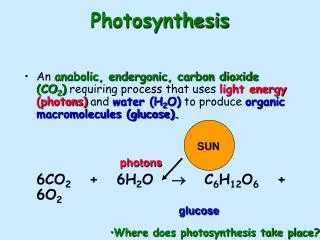
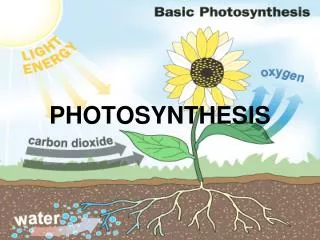
Solar energy + CO2 + H2O ? (CH2O) + O2
10. Mader: Biology, 9th Ed. Photosynthesis Overview
11. Mader: Biology, 9th Ed. Photosynthetic Reaction Light Reaction - Chlorophyll absorbs solar energy and energizes electrons
Electrons move down electron transport chain
Pumps H+ into thylakoids
Used to make ATP out of ADP and NADPH out of NADP
Calvin Cycle Reaction - CO2 is taken up and reduced to a carbohydrate
Reduction requires ATP and NADPH
12. Mader: Biology, 9th Ed. Light Reactions Light reactions consist of two electron pathways:
Noncyclic electron pathway
Cyclic electron pathway
Capture light energy with photosystems
Pigment complex helps collect solar energy like an antenna
Occur in the thylakoid membranes
Both pathways produce ATP, but only the noncyclic pathway also produces NADPH
13. Mader: Biology, 9th Ed. Noncyclic Electron Pathway Electrons flow from water to NADPH
Uses 2 photosystems, PS I and PS II
Photosystem consists of pigment complex and electron acceptor molecules in the thylakoid membrane
Pigment complex helps gather solar energy
Reaction center – pair of chlorophyll a molecules where electrons are concentrated
14. Mader: Biology, 9th Ed. Noncyclic Electron Pathway PS II captures light energy
Causes an electron to be ejected from the reaction center (chlorophyll a)
Electron travels down electron transport chain to PS I
Replaced with an electron from water
Which causes H+ to concentrate in thylakoid chambers
Resulting in ATP production
15. Mader: Biology, 9th Ed. Noncyclic Electron Pathway PS I captures light energy and ejects an electron
Transferred permanently to a molecule of NADP+
Resulting in NADPH production
16. Mader: Biology, 9th Ed. Cyclic Electron Pathway Cyclic pathway involves PS I
PS I pigment complex absorbs solar energy and passes it from one pigment to another until it is concentrated in a reaction center
Pathway only results in ATP production
17. Mader: Biology, 9th Ed. Thylakoid Organization PS II
Pigment complex and electron-acceptors
Adjacent to an enzyme that oxidizes water
Oxygen is released as a gas
Electron Transport System
Consists of cytochrome complexes
Carries electrons between PS II and PS I
Also pump H+ from the stroma into thylakoid space
18. Mader: Biology, 9th Ed. Thylakoid Organization PS I
Pigment complex and electron acceptors
Adjacent to enzyme that reduces NADP+ to NADPH
ATP Synthase Complex
Has a channel for H+ flow
Which drives ATP synthase to join ADP and Pi
19. Mader: Biology, 9th Ed. ATP Production Thylakoid space acts as a reservoir for hydrogen ions (H+)
Each time water is oxidized, two H+ remain in the thylakoid space
Electrons yield energy
Used to pump H+ across thylakoid membrane
Move from stroma into the thylakoid space
Flow of H+ back across thylakoid membrane
Energizes ATP synthase
Enzymatically produces ATP from ADP + Pi
This method of producing ATP is called chemiosmosis
20. Mader: Biology, 9th Ed. Calvin Cycle Reactions Calvin cycle is a series of reactions that produce carbohydrates before returning to the starting point
Utilizes atmospheric CO2 to produce carbohydrates
Known as C3 photosynthesis
Includes the following processes:
Carbon dioxide fixation
Carbon dioxide reduction
RuBP Regeneration
21. Mader: Biology, 9th Ed.
22. Mader: Biology, 9th Ed. Calvin Cycle Reactions Carbon Dioxide Fixation
CO2 is attached to RuBP resulting in a 6-carbon molecule which splits into two 3-carbon molecules (3PG)
Rubisco (RuBP Carboxylase) is enzyme used
23. Mader: Biology, 9th Ed. Calvin Cycle Reactions Reduction of Carbon Dioxide
24. Mader: Biology, 9th Ed. Calvin Cycle Reactions Regeneration of RuBP
25. Mader: Biology, 9th Ed. Importance of Calvin Cycle PGAL or G3P (glyceraldehyde-3-phosphate) is the product of the Calvin cycle that can be converted to a variety of organic molecules
26. Mader: Biology, 9th Ed. C4 Photosynthesis In hot, dry climates, net photosynthetic rate of C4 plants is about 2-3 times that of C3 plants
Stomata must close to avoid wilting
CO2 decreases and O2 increases
O2 starts combining with RuBP instead of CO2
Photorespiration, avoided in C4 plants
In C4 leaf, bundle sheath cells and mesophyll cells contain chloroplasts
Mesophyll cells are arranged concentrically around the bundle sheath cells
27. Mader: Biology, 9th Ed. C3 vs C4
28. Mader: Biology, 9th Ed. CO2 Fixation in C3 and C4 Plants
29. Mader: Biology, 9th Ed. CAM Photosynthesis Crassulacean-Acid Metabolism
C4 plants partition carbon fixation in space, while CAM partitions by time
During the night, CAM plants fix CO2, forming C4 molecules, which are stored in large vacuoles
C4 molecules release CO2 to Calvin cycle when NADPH and ATP are available
Water Conservation
30. Mader: Biology, 9th Ed. CAM Photosynthesis
31. Mader: Biology, 9th Ed.