Applications of Thomson Diffusion in Plasma and Ultra-Short X-Ray Source Monitoring
This document explores the applications of Thomson diffusion in monitoring plasma and high-temperature gases. It describes how a laser beam interacts with free plasma electrons, scattering light for precise observation. Utilizing the TCV Thomson scattering setup, the scattered laser light is measured at 25 points around the plasma. Additionally, it discusses Rayleigh scattering techniques that depend on gas density and refractive index, enabling fluid dynamics monitoring of macromolecules, particles, and flame development imaging.

Applications of Thomson Diffusion in Plasma and Ultra-Short X-Ray Source Monitoring
E N D
Presentation Transcript
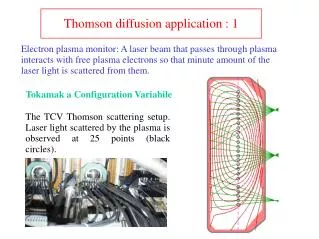
Thomson diffusion application : 1 Electron plasma monitor: A laser beam that passes through plasma interacts with free plasma electrons so that minute amount of the laser light is scattered from them. Tokamak a Configuration Variabile The TCV Thomson scattering setup. Laser light scattered by the plasma is observed at 25 points (black circles).
Thomson diffusion application: 2 Ultra short X-RAY SOURCE from Th. SCATTERING: the laser fotons are “classical” in the beam rest frame → Th. Sc.
Rayleigh diffusion application Rayleigh crosssection depends on density, i.e. on refraction index. More dense region deflects more a laser beam→ can be used to monitor the fluidodynamics of high temperature gases, macromolecules and a wide range of particles in solution. Flame development by R. imaging : laser beam modulated by R.D. In the gas n= refraction index N = gas density