Substitutions
This document provides an analysis of expected versus observed responses in a language processing task involving a sentence about a small boy running down a hill. The various types of corrections include marking, unsuccessful corrections, omissions, insertions, and pauses. Each scenario examines how closely the observed response aligns with the expected sentence structure. The insights gained from this analysis can help in understanding language acquisition and error correction mechanisms.

Substitutions
E N D
Presentation Transcript
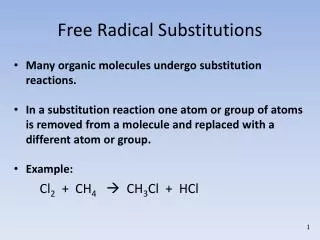
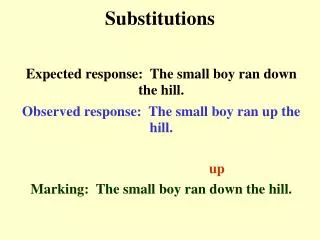
Substitutions Expected response: The small boy ran down the hill. Observed response: The small boy ran up the hill. up Marking: The small boy ran down the hill.
Correction Expected Response: The small boy ran down the hill. Observed Response: The small boy ran up down the hill. c up Marking: The small boy ran down the hill.
Unsuccessful Correction Expected Response: The small boy ran down the hill. Observed Response: The small boy ran down the road, down the road. uc road Marking: The small boy ran down the hill.
Abandons Correct Form Expected Response: The small boy ran down the hill. Observed Response: The small boy ran down the hill, the road. ac road Marking: The small boy ran down the hill.
Repeat Expected Response: The small boy ran down the hill. Observed Response: The small boy ran down the hill, the hill. R Marking: The small boy ran down the hill.
Omission Expected Response: The small boy ran down the hill. Observed Response: The boy ran down the hill. Marking: The small boy ran down the hill.
Insertion Expected Response: The small boy ran down the hill. Observed Response: The small boy ran down the big hill. big Marking: The small boy ran down the hill.
Pause Expected Response: The small boy ran down the hill. Observed Response: The small boy ran down the ...(6 seconds)... hill. 6 Marking: The small boy ran down the hill.