Bonding
Explore the fundamentals of bonding, including valence electrons and the octet rule, which determines chemical properties. Learn how cations are formed by losing valence electrons to achieve noble gas configurations, while anions form by gaining electrons. Delve into ionic compounds, their characteristics, and their formation, including writing ionic formulas and naming conventions. Discover covalent bonds, their properties, and the use of prefixes for naming. Understand Lewis structures and VSEPR theory for predicting molecular shapes.

Bonding
E N D
Presentation Transcript
Valence Electrons • In the highest energy level • Determine chemical properties. • Elements bond to get 8 valence e- (octet rule)
Anions, Cations, and Electron Configuration Cations form by losing valance electrons to take on a noble gas configuration (ns2np6)
Anions, Cations, and Electron Configuration Cations form by losing valance electrons to take on a noble gas configuration (ns2np6) So Li loses the 2s1 electron to form Li+1. Mg loses both 3s2 electrons to form Mg+2 Al loses three electrons from 3s23p1 to form Al+3
Anions, Cations, and Electron Configuration Anions form by gaining valance electrons to take on a noble gas configuration (ns2np6) So F becomes F1- by gaining a 2p electron to have the new valance configuration 2s22p6. S becomes S2- by gaining two 2p electrons to have the new valance configuration 3s23p6. N becomes N3- by gaining three 2p electrons to have the new valance configuration 2s22p6.
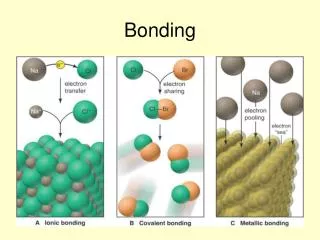
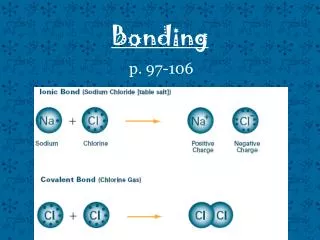
Ionic Compounds • Made of metal cations (+) and nonmetal anions (-) • Have no charge • Solid at room temperature • High melting points • Conduct electric current when dissolved in water Na+ Cl-
Writing Ionic Formulas Aluminum and oxygen • Write each ion with the correct charge (cations first!) • Bring the charge # (NOT the + or -) down as a subscript and switch which element it goes to Al3+ O2- Al2O3
Naming Ionic Compounds • Name of the cation • Roman numeral for cations with mutliple + charges • Name the anion • ide is single anion • -ate or -ite is polyatomic CaF2 Li3PO4 PbS2 Calcium fluoride Lithium phosphate Lead (IV) sufide
Covalent Bonds • Nonmetal atoms are held together by sharing electrons • low melting and boiling point • All phases at room temperature
Diatomic Molecules H2, N2, O2, F2, Cl2, Br2, I2, At2
Naming and Writing Formulas for Covalent Compounds Indicate # of each atom using prefixes (mono, di, tri, tetra, penta, hexa, hepta, octa, nona, deca) The first element does not use mono if there’s only one. • NO2 • P2O4 nitrogen dioxide diphosphorus tetroxide
Lewis Structures Step 1: Set up the following table to determine bond numbers Step 2: Connect atoms based on bond numbers calculated Step 3: Fill octets with unshared electrons
VSEPR THEORY Valence Shell Electron Pair Repulsion . . bent tetrahedaral linear . . Trig planar Trig pyramid