Download
1 / 1
10 likes | 140 Views
This research explores innovative X-ray imaging techniques, extending DIC microscopy into the X-ray wavelength for improved imaging of weakly absorbing phase objects. A Fourier optical element is proposed as a substitute for micro-zone plates, allowing the same number of elements as traditional TXM but enhancing ease of alignment and existing apparatus adaptability. Additionally, off-axis X-ray holography is evaluated for its quantifiable absorption and phase capabilities, particularly advantageous in studying biological specimens and magnetic materials, despite needing specialized setups.

E N D
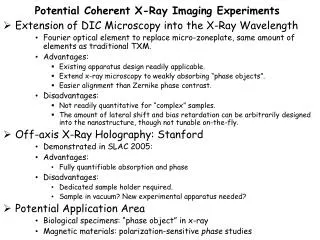
Potential Coherent X-Ray Imaging Experiments • Extension of DIC Microscopy into the X-Ray Wavelength • Fourier optical element to replace micro-zoneplate, same amount of elements as traditional TXM. • Advantages: • Existing apparatus design readily applicable. • Extend x-ray microscopy to weakly absorbing “phase objects”. • Easier alignment than Zernike phase contrast. • Disadvantages: • Not readily quantitative for “complex” samples. • The amount of lateral shift and bias retardation can be arbitrarily designed into the nanostructure, though not tunable on-the-fly. • Off-axis X-Ray Holography: Stanford • Demonstrated in SLAC 2005: • Advantages: • Fully quantifiable absorption and phase • Disadvantages: • Dedicated sample holder required. • Sample in vacuum? New experimental apparatus needed? • Potential Application Area • Biological specimens: “phase object” in x-ray • Magnetic materials: polarization-sensitive phase studies