Download
1 / 28
280 likes | 417 Views
This presentation introduces an innovative method for spatial regularization in fMRI analysis, integrating anatomical priors to improve activation detection. We empirically compare our approach against traditional techniques, utilizing Mean Field Approximation and Markov Random Field models. The method addresses challenges like over-smoothing and leverages anatomical information to enhance the accuracy of activation maps. Our experimental evaluation, grounded in synthetic and real fMRI data, demonstrates significant improvements, paving the way for more reliable neuroimaging insights.

E N D
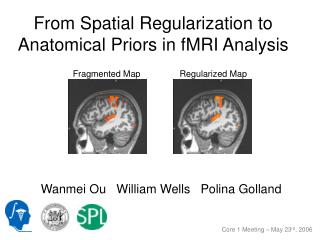
From Spatial Regularization to Anatomical Priors in fMRI Analysis Fragmented Map Regularized Map Wanmei Ou William Wells Polina Golland Core 1 Meeting – May 23rd, 2006
Main Contributions • Propose new spatial regularization method: Incorporating Anatomical Information • Empirically Compare proposed methods with traditional methods
Road Map • Background and Motivation • Markov Random Field (MRF) and Anatomical Guided MRF Model • Mean Field Approximation Solver • Experimental Evaluation • Conclusions
Road Map • Background and Motivation • Markov Random Field (MRF) and Anatomical Guided MRF Model • Mean Field Approximation Solver • Experimental Evaluation • Conclusions
From fMRI Images to fMRI Analysis Image Acquisition MRI fMRI Task protocol: Auditory, Vision, etc. Spatial Regularization Voxel-by-voxel detector Threshold Activation Map Scatter activation
Road Map • Background and Motivation • Markov Random Field (MRF) and Anatomical Guided MRF Model • Mean Field Approximation Solver • Experimental Evaluation • Conclusions
Goal and Approaches Goal: Recover True Activation through Spatial Regularization Our Approach: • Incorporate MRF into General Linear Model (GLM) Statistic • Include Anatomical Information into MRF
Detailed Approaches Our Approach: • 1. Incorporate MRF into GLM Statistic • Capture spatial dependency • Overcome over-smoothing effect • 2. Include Anatomical Information into MRF • Activation is more likely in gray matter • Spatial dependency is strong within tissue type Activation Maps MRF MRI Synthetic Ground Truth Segmentation Gray, White, Other
General Linear Model (GLM) Protocol-Independent Signal Two Hypotheses Not-active voxel Active voxel Protocol-Dependent Signal GLM ML Estimate F or T statistic P-value Traditional Approach General Log Likelihood Ratio (Cosman, 04) Our Approach
Markov Random Field Spatial Priors: Likelihood: -- Hidden Activation State -- Noisy Observation/Statistic MAP Estimate:
Incorporating Anatomical Information Combine activation state & tissue type MRI Segmentation -- Hidden Activation State -- Tissue Type MAP Estimate: -- Segmentation Label -- Noise Statistic
Markov Random Fields Solvers • Binary MRF Min-Cut/Max-Flow (Min-Max) Binary MRF Only • Gibbs Sampling Slow • Simulated Annealing Slow • Belief Propagation Fast, Approximation • Mean Field Fast, Approximation
Road Map • Background and Motivation • Markov Random Field (MRF) and Anatomical Guided MRF Model • Mean Field Approximation Solver • Experimental Evaluations • Conclusion and Future work
Mean Field • Approximate by • Iterative up-date rule Belief: Prob. Of voxel is active • Approximated MAP
Mean Field Similar up-date rule while incorporating anatomical information Approximated MAP
Alternative Anatomically Guided Filters • No smoothing with Anatomical Information • Suppress all activation in the non-gray matter. • Anatomically Guided Gaussian Filter • Adjust weights based on segmentation labels.
Road Map • Background and Motivation • Markov Random Field (MRF) and Anatomical Guided MRF Model • Mean Field Approximation Solver • Experimental Evaluation • Synthetic Data • Real fMRI Data • Conclusions
Experiments – Synthetic Data Sets Low SNR Fragmented Activation Maps Noise SNR = -6.3dB Noise SNR = -9.3dB Activation Maps Threshold: False positive = 0.05% Forward Model GLM Detector + Synthetic Ground Truth
Experiments – Synthetic Data Sets Noise Forward Model GLM with different smoothing methods + Synthetic Ground Truth • No Smoothing • No Smoothing w/ Anatomical Info • Gaussian Smoothing w/o Anatomical Info • Gaussian Smoothing w/ Anatomical Info • MRF w/o Anatomical Info • MRF w/ Anatomical Info
ROC Analysis Without Anatomical Information Min-Max (Exact Solver) vs. Mean Field (Approximation) SNR = -6dB SNR = -9dB
ROC Analysis Without Anatomical Information MRF (Mean Field) vs. Gaussian Smoothing SNR = -6dB SNR = -9dB
ROC Analysis With Anatomical Information MRF (Mean Field) vs. Gaussian Smoothing SNR = -6dB SNR = -9dB
Road Map • Background and Motivation • Markov Random Field (MRF) and Anatomical Guided MRF Model • Mean Field Approximation Solver • Experimental Evaluation • Synthetic Data • Real fMRI Data • Conclusions
Evaluation on Real Data “Ground Truth” GLM Majority Voting GLM 8 task epochs comparisons GLM with various spatial regularizers 2 task epochs
Activation Maps Comparison Anat No Smoothing Gaussian MRF “Ground Truth” No Smoothing+Anat Gaussian+Anat MRF+Anat Three Epochs sm007ep3
Activation Maps Comparison Anat No Smoothing Gaussian MRF “Ground Truth” No Smoothing+Anat Gaussian+Anat MRF+Anat Three Epochs sm007ep3
Activation Maps Comparison Anat No Smoothing Gaussian MRF “Ground Truth” No Smoothing+Anat Gaussian+Anat MRF+Anat Three Epochs sm007ep3
Conclusions • New Spatial Regularization method • Anatomical Bias • Empirical Evaluation • ROC analysis • Activation maps • MRF + Anatomical Information • Increase detection accuracy with reduced-length signal