Appendicular Skeleton
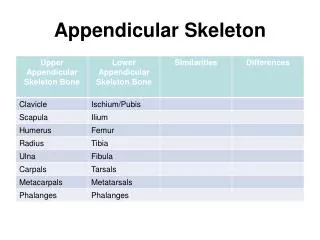
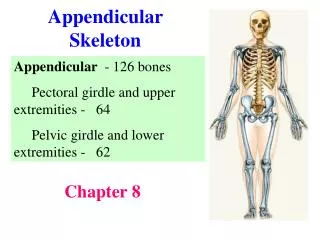
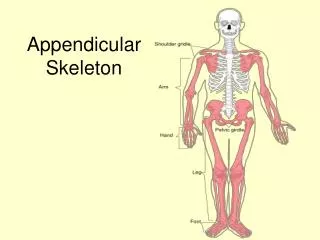
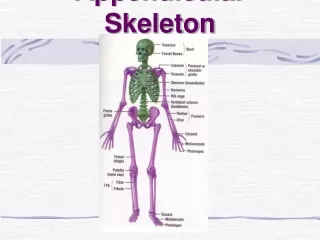
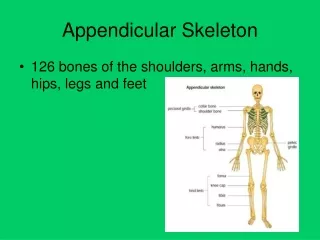
The appendicular skeleton comprises 126 bones, designed for movement and mobility, and is suspended by girdles from the axial skeleton. It includes the pectoral girdle (4 bones), upper extremities (30 bones), pelvic girdle (2 bones), and lower extremities (30 bones). The pectoral girdle consists of the clavicle and scapula, while the pelvic girdle supports body weight and connects legs to the axial skeleton. Each limb is composed of various bones, such as the humerus, femur, and phalanges, allowing for coordinated movement and function.

Appendicular Skeleton
E N D
Presentation Transcript
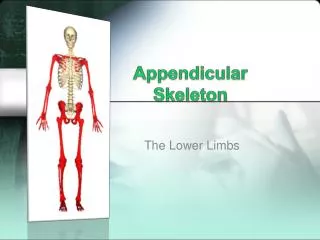
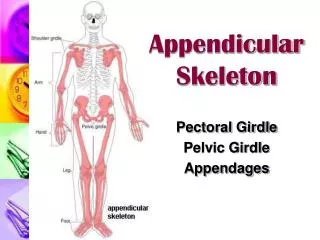
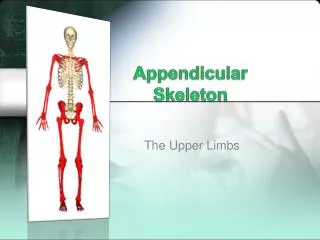
Appendicular Skeleton • 126 bones – suspended by girdles from axial skeleton • Designed for movement • Pectoral girdle – 4 bones • Upper extremity -Arm – 1 bone - forearm – 2 bones - hand = wrist, palm & fingers – 27 bones [each]
Pelvic Girdle – 2 bones • Lower Extremity – leg – 1 bone • - lower leg – 2 bones • - foot = ankle, instep & toes – 26 bones [each ] • - Patella – 2 bones • *Pelvic or Hip Girdle: • Attaches the lower extremity to the axial skeleton • Provides support for body weight
Hip / Coxal bones [ ossa coxae, innominate bones] Ilium – ASIS, PSIS Ischium - tuberosity Pubis - rami Symphysis pubis Obturator foramen Acetabulum
Lower Extremity • Leg [thigh] – femur Head Fovea capitis Neck Trochanters – greater/lesser Condyles – medial/lateral Epicondyles
Lower Extremity *Leg – region between knee and ankle • Fibula – lateral bone • Tibia – medial bone Malleolus Condyles – medial/lateral Tibial tuberosity
Patella [kneecap] a flat, triangular sesamoid bone Enclosed within the quadriceps tendon
Ankle or Tarsus Contains 7 tarsal bones Calcaneous = heel bone Talus Cuboid Navicular Cuneiforms – lateral, intermediate & medial
Foot • Metatarsals – not named, but numbered 1 – 5 starting at medial side • Toes – phalanges or digits: 3 bones [proximal, distal & middle] for each toe, except big [great] toe which has 2 [no middle phalanx]
Pectoral or Shoulder Girdle • Clavicle [collarbone] – ‘S’ shaped bone * most frequently fx’d bone of body • Scapula [shoulder blade] – thin, flat, triangular bone. • Acromion • Spine • Coracoid process • Gleniod fossa/cavity
Upper Extremity • Arm [brachium] humerus Head Tubercles – greater/lesser Epicondlyes – medial/lateral Olecranon fossa Capitulum Trochlea
Upper Extremity *forearm – region between elbow and wrist • Ulna Olecranon process • Radius head Styloid process
Wrist or Carpus • Contains 8 carpal bones Bound tightly by ligaments Arranged in 2 rows Scaphoid Trapezium Lunate Trapezoid Triquetral Capitate Pisiform Hamate
Hand • Metarcarpals – not named, but numbered 1-5 starting on lateral [thumb] side • Fingers – phalanges or digits: 3 bones [proximal, distal & middle] for each finger, except thumb, which has 2 [ no middle phalanx]