9. Linking and Sharing
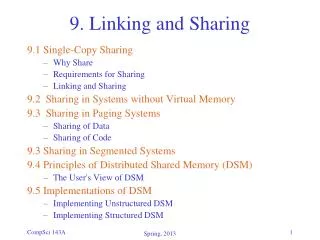
9. Linking and Sharing. 9.1 Single-Copy Sharing Why Share Requirements for Sharing Linking and Sharing 9.2 Sharing in Systems without Virtual Memory 9.3 Sharing in Paging Systems Sharing of Data Sharing of Code 9.3 Sharing in Segmented Systems

9. Linking and Sharing
E N D
Presentation Transcript
9. Linking and Sharing 9.1 Single-Copy Sharing • Why Share • Requirements for Sharing • Linking and Sharing 9.2 Sharing in Systems without Virtual Memory 9.3 Sharing in Paging Systems • Sharing of Data • Sharing of Code 9.3 Sharing in Segmented Systems 9.4 Principles of Distributed Shared Memory (DSM) • The User's View of DSM 9.5 Implementations of DSM • Implementing Unstructured DSM • Implementing Structured DSM Spring, 2013
Single-Copy Sharing • Focus: sharing a single copy of code or data in memory • Why share? • Processes need to access common data • Producer/consumer, task pools, file directories • Better utilization of memory • code, system tables, data bases Spring, 2013
Requirements for Sharing • Requirement for sharing • How to express what is shared • A priori agreement (e.g., system components) • Language construct (e.g., UNIX’s shmget/shmat) • Shared code must be reentrant (also known as read-only or pure) • Does not modify itself (read-only segments) • Data (stack, heap) in separate private areas for each process Spring, 2013
Linking and Sharing • Linking resolves external references • Sharing links the same copy of a module into two or more address spaces • Static linking/sharing: • Resolve referencesbefore execution starts • Dynamic linking/sharing: • While executing Figure 9-1 Spring, 2013
Sharing without Virtual Memory • With one or no Relocation Register (RR) • All memory of a process is contiguous • Sharing user programs: • Possible only with 2 user programs by partial overlap • Too restrictive and difficult; generally not used • Sharing system components: • Components are assigned specific, agreed-upon starting positions • Linker resolves references to those locations • Can also use a block of transfer addresses,but this involves additional memory references. Spring, 2013
Sharing without Virtual Memory • With multiple RRs • CBR = Code Base Register Point to shared copy of code • SBR = Stack Base Register Point to private copy of stack • DBR = Data Base Register Point to private copy of data Figure 9-2 Spring, 2013
Sharing in Paging Systems • Data pages • Code pages • Generally, want to avoid requiring shared page to have the same page number in all processes that share it • Code, data could be shared by many processes • Could easily lead to conflicts Spring, 2013
Sharing in Paging Systems • Sharing of data pages: • Page table entries of different processes point to the same page • If shared pages contain only data and no addresses, linker can • Assign arbitrary page numbers to the shared pages • Adjust page tables to point to appropriate page frames • So the shared page can have a different page number in different processes Figure 9-3 Spring, 2013
Sharing in Paging Systems • Sharing of code pages • Key issues: • Self-references: references to the shared code from within the shared code • Linking the shared code into multiple address spaces Spring, 2013
Sharing of Code Pages in Paging Systems • Self references: • avoid page numbers in shared code by compiling branch addresses relative to CBR • This works provided the shared code is self-contained (does not contain any external references ) • Linking shared pages into multiple address spaces: • Issues: • Want to defer loading of code until we actually use it • When process first accesses the code, it may have already been loaded by another process • Done through dynamic linkingusing a transfer vector Figure 9-3 Spring, 2013
Dynamic Linking via Transfer Vector • Each Transfer Vector entry corresponds to a reference to shared code • Each entry initially contains a piece of code called a stub • Stub code does the following: • Checks whether referenced shared code is loaded. • If the shared code is not already loaded, the stub loads the code • Stub code replaces itself by a direct reference to the shared code Figure 9-4 Spring, 2013
Sharing in Segmented Systems • Much the same as with Paged Systems • Simpler and more elegant because segments represent logical program entities • ST entries of different processes point to thesame segment in physical memory (PM) • Data pages, containing only data and no addresses: same as with paged systems • Code pages: • Assign same segment numbers in all STs, or • Use base registers: • Function call loads CBR • Self-references have the form w(CBR) • This works if shared segments are self-contained (i.e., it they do not contain any references to other segments). • Full generality can be achieved using private linkage sections, introduced in Multics (1968). Spring, 2013
Unrestricted Dynamic Linking/Sharing • Basic Principles (see Figure 9-5 on next page): • Self-references resolved using CBR • External references are indirectvia a private linkage section • External reference is (S,W), where S and W are symbolic names • At runtime, on first use: • Symbolic address (S,W) is resolved to (s,w), using trap mechanism) • (s,w) is entered in linkage section of process • Code is unchanged • Subsequent references use (s,w) without involving OS • Forces additional memory access for every external reference Spring, 2013
Dynamic Linking/Sharing Before and After External Reference is Executed Figure 9-5a: Before Figure 9-5b: After Spring, 2013
Distributed Shared Memory • Goal: Create illusion of single shared memory in a distributed system • The (ugly) realityis that physical memory is distributed. • References to remote memory trigger hidden transfers from remote memory to local memory • Impractical/Impossible to do this one reference at a time. • How to implement transfers efficiently? • Optimize the implementation.Most important with Unstructured DSM. • Restrict the user. (Exploit what the user knows.)Basic to Structured DSM. Spring, 2013
Unstructured DSM Simulate single, fully shared, unstructured memory. (Unlike paging, a CPU has no private space.) Figure 9-6 • Advantage: Fully transparent to user • Disadvantage: Efficiency. Every instruction fetch or operand read/write could be to remote memory Spring, 2013
Structured DSM • Each CPU has both private and shared space. • Add restrictions on use of shared variables: • Access only within (explicitly declared) Critical Sections • Modifications only need to be propagated at beginning/end of critical sections. • Variant: Use objects instead of shared variables: object-based DSM Figure 9-7 Spring, 2013
Implementing Unstructured DSM • Key Issues: • Granularity of Transfers • Replication of Data • Memory Consistency: Strict vs Sequential • Tracking Data: Where is it stored now? Spring, 2013
Implementing Unstructured DSM • Granularity of Transfers • Transfer too little: • Time wasted in latency • Transfer too much: • Time wasted in transfer • False sharing: • Two unrelated variables, each accessed by a different process, are on the same page/set of pages being transferred between physical memories • Can result in pages being transferred back and forth, similar to thrashing Spring, 2013
Implementing Unstructured DSM • Replication of Data: Move or Copy? • Copying saves time on later references. • Copying causes (cache or real) consistency confusion. • Reads work fine. • Writes require others to update or invalidate. Figure 9-9 Spring, 2013
Implementing Unstructured DSM • Strict Consistency: Reading a variable x returns the value written to xby the most recently executed write operation. • Sequential Consistency: Sequence of values of x read by different processes corresponds to some sequential interleaved execution of those processes. Figure 9-11 • Reads of x in p1will always produce (1,2) • Reads of x in p2can produce (0,0), (0,1),(0,2), (1,1), (1,2), or(2,2) Spring, 2013
Implementing Unstructured DSM • Tracking Data: Where is it stored now? • Approaches: • Have owner track it by maintaining copy set (list).Only owner is allowed to write. • Ownership can change when a write request is received.Now we need to find the owner. • Use broadcast. • Central Manager (→ Bottleneck). Replicated managers share responsibilities. • Probable owner gets tracked down. Retrace data’s migration. Update links traversed to show current owner. • Bottom line on Unstructured DSM: • Isn’t there a better way? Spring, 2013
Implementing Structured DSM • Memory Consistency • Unstructured DSM assume that all shared variables are consistent at all times. This is a major reason why the performance is so poor. • Structured DSM introduces new, weaker models of memory consistency • Weak consistency • Release consistency • Entry consistency Spring, 2013
Implementing Structured DSM • Weak Memory Consistency • Introduce synchronization variable S • Processes access S when they areready to adjust/reconcile their shared variables. • The DSM is only guaranteed to be in a consistent state immediately following access to a synchronization variable Figure 9-12 Spring, 2013
Implementing Structured DSM • Release Memory Consistency • Export modified variables upon leaving CS Figure 9-13 – This is a waste if p2 never looks at x. Spring, 2013
Implementing Structured DSM • Entry Memory Consistency • Associate each shared variable with a lock variable • Before entering CS, import only those variables associated with the current lock Figure 9-14 • There is also a (confusingly named?) lazy release consistency model which imports all shared variables before entering CS Spring, 2013
Object-Based DSM • An object’s functions/methods are part of it. • Can use remote method invocation(like remote procedure calls, covered earlier)instead of copying or moving an object intolocal memory. • Can also move or copy an object to improve performance. • When objects are replicated, consistency issues again arise (as in unstructured DSM) • On write, we could • Invalidate all other copies (as in unstructured DSM) • Remotely invoke, on all copies, a method that does the same write Spring, 2013
Memory Models on Multiprocessors • Processors share memory • Each processor may have its own cache • Memory models provide rules for deciding • When processor X sees writes to memory by other processors • When writes by processor X are visible to other processors • These questions are similar to some of the issues that arise in distributed shared memory . Spring, 2013
Java Memory Model Similar issues arise in multithreaded code in Java • Each thread may have its own copy of shared variables • Threads may read from and write to their own copy of shared variables. • The Java Memory Model specifies • When thread X must see writes to memory by other processors • When writes by thread X must become visible to other processors • The issues in Java are different from those in other languages such as C/C++: • Threads are an integral part of the Java language. • Java compilers can rearrange thread code as part of optimization • To achieve correctness, certain conditions must be guaranteed. Spring, 2013
Java Memory Model (continued) • Full details in JSR 133 (2004). • A happened-before relation is defined on memory references, locks, unlocks, and other thread operation. • If one action happened-before the other according to this definition, then the Java Virtual Machine guarantees that the results of the first action are visible to the second action • Example: • If x=1happened-before y=xand no other assignment to x intervenes, then y must be set to 1. • But if it is not true that x=1 happened-before y=x, then y will not necessarily be set to 1. • Note that this is a separate issue from mutual exclusion, although the two are related. Spring, 2013
Java Memory Model (continued) • Some rules defining the happened before relation (not a complete list): • An action in a thread happened-before an action in that thread that comes later in the thread’s sequential order. • An unlock on an object happened-before every subsequent lock on that same object. • A write to a volatile field happened-before every subsequent read of that same volatile field. • A call to start() on a thread happened-before any actions within the thread. • All actions within a thread happened-before any other thread returns from a join() on that thread. • A write by a thread to a blocking queue happened-before any subsequent read from that blocking queue. • There are other rules. The compiler is free to reorder operations as long as the happened-before operation is respected. Spring, 2013
History • Originally developed by Steve Franklin • Modified by Michael Dillencourt, Summer, 2007 • Modified by Michael Dillencourt, Spring, 2009 • Modified by Michael Dillencourt, Winter 2011 (added material on Java memory model) Spring, 2013