Download
1 / 6
60 likes | 202 Views
This exploration delves into the similarities and differences between the healthcare systems of Scotland and England. Both systems prioritize universal access, comprehensive care, and a strong primary care tradition, characterized by general practitioners acting as gatekeepers. However, they diverge significantly in their organizational structures, funding models, and integration levels. Scotland's unified boards contrast with England's purchaser-provider split and reliance on multiple funding streams. This analysis aims to identify effective improvement models while emphasizing the importance of integration for optimal patient outcomes.

E N D
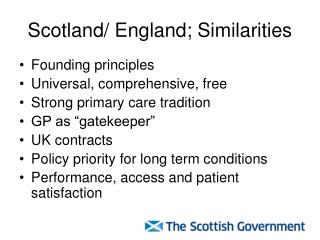
Scotland/ England; Similarities • Founding principles • Universal, comprehensive, free • Strong primary care tradition • GP as “gatekeeper” • UK contracts • Policy priority for long term conditions • Performance, access and patient satisfaction
Scotland/ England; Differences • E – purchaser provider split S – unified Boards • E – PCTs, Hospital Trusts, Foundation Trusts, MH Trusts etc S – Unified Boards (CHPs too) • E – Practice based commissioning S – Unified Boards
More differences • E – open to competition and the market S – closed to competition and the market • E – many funding streams S – few funding streams • E – more autonomous (fragmented) S – more integrated (centralised)
Different improvement models From LeGrand 2007
Integration; the key to the interface? • Shared outcomes • Systems/ Infrastructure • Clinical/ Provider • Financial • Service delivery and patient experience • Culture and ethos