Download
1 / 17
170 likes | 285 Views
This course, led by Dr. Tim Reddish at the University of Windsor, explores the fundamentals of astronomy with a focus on the solar system. Classes are held Tuesdays and Thursdays from 5:30 to 6:20 PM. Students will access course materials and notes through a password-protected website. Assessments include a mid-term, quizzes, and a cumulative final exam focused on understanding key concepts and equations in astronomy. Office hours are flexible to support student needs. Important resources include the textbook "Astronomy Today" and various supplementary materials.

E N D
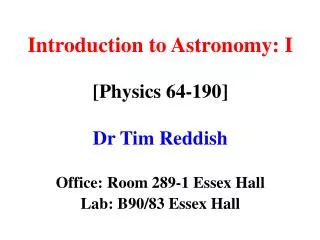
Introduction to Astronomy: I [Physics 64-190] Dr Tim Reddish Office: Room 289-1 Essex Hall Lab: B90/83 Essex Hall
Time and Place Tuesdays and Thursdays 5:30 – 6:20pm Chrysler Hall North G133
Class Notes Web Site • Access via University links to ‘Class Notes’ • Password protected! ID & Password Your normal U of Windsor Account Course Outline, PowerPoint presentations, Useful Links & Movies are all available there.
Office Hours • “Open Door” Policy. • No regular times are scheduled in order to accommodate students’ diverse timetables. • I will generally be in either Essex 289-1 or B90 / B83 (Basement) and can be found most days. • If, for some reason, your queries cannot be addressed at that time, we can schedule a further meeting.
Course Text Bookfor 64-190 & 191 “Astronomy Today” Chaisson and McMillan (Part 1: The Solar System) Prentice Hall (2007) Alternatives: Astronomy: from the Earth to the Universe Pasachoff Universe: The Solar System Freedman and Kaufmann
One Mid-Term Weight = 30% Dates: Thursday29th October 2009 Place: Ambassador Auditorium Time: 17:30 – 18:45
Class Quizzes Announced within 48 hours of the Quiz (i.e. in class and on web site) Weight = 20%
Final Examination Weight : 50% Provisional Date: Thursday, 17th December 2009 15:30hrs The Final Exam is ‘Cumulative’!
Style of Exams Multiple Choice (mainly) ‘Fill-in the blanks’
Important Notice! • All Assessments are compulsory. • There will be no ‘make-up’ examinations for scheduled tests and examinations without acceptable and verifiable medical (or equivalent compassionate) reasons. • Any ‘medical notes’ must be submitted prior to the relevant midterms or final exam.
MATH?! GOOD NEWS! • There is a minimal amount of math! • No calculations will be expected! BAD NEWS! There are a few equations to be understood: i.e. know what they mean!
Example! What does “E = mc2” mean? Newton has a similarly famous equation for gravity…
Syllabus Parts 1 & 2 in “Astronomy Today” More Specifically: • Charting the Heavens: Foundations of Astronomy • The Copernican Revolution 8) The Moon and Mercury
Syllabus Continued 9) Venus: the Earth’s sister planet 10) Mars 11) Jupiter and its Moons 12) Saturn and its Rings 13) Uranus, Neptune and Pluto 14 &15) The Formation of the Solar System. 7) The Earth 4 & 5) Learning from Light (Bonus lecture – time permitting)
Important Note: • Ultimately: the syllabus is defined by the lecture material, notthe contents of the book. • The purpose of the book is a resourcefor more information detailed explanations. • Good Advice: Do the ‘self-tests’ after we have covered each Chapter! Ask Questions!
Special Needs Students… Please identify yourself to me after this class. Please make use of the web material…