
Uploaded by
sol
0 SLIDES
148 VIEWS
0LIKES
Lecture 2
DESCRIPTION
Lecture 2. 2.1 Sources 2.2 Ohm’s Law 2.4 Kirchhoff’s Laws. Voltage and Current Sources. Independent Sources. Characteristics. An independent source establishes a voltage or current in a circuit without relying on voltages and currents elsewhere in the circuit.
Download

1 / 0
Download Presentation 
Lecture 2
An Image/Link below is provided (as is) to download presentation
Download Policy: Content on the Website is provided to you AS IS for your information and personal use and may not be sold / licensed / shared on other websites without getting consent from its author.
Content is provided to you AS IS for your information and personal use only.
Download presentation by click this link.
While downloading, if for some reason you are not able to download a presentation, the publisher may have deleted the file from their server.
During download, if you can't get a presentation, the file might be deleted by the publisher.
E N D
Presentation Transcript
-
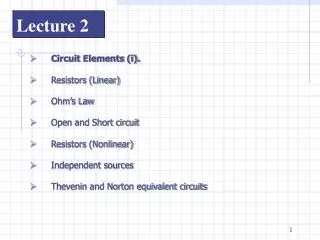
Lecture 2
2.1 Sources 2.2 Ohm’s Law 2.4 Kirchhoff’s Laws - Voltage and Current Sources
- Independent Sources
- Characteristics An independent source establishes a voltage or current in a circuit without relying on voltages and currents elsewhere in the circuit. The value of the voltage or current supplied is specified by the value of the independent source alone.
- Exercise
- Electrochemistry of a Lemon Battery - e- + Add standard reduction potential to obtain the voltage across the terminals. Zn→Zn2++2e- +0.76 V +0.34 V Cu2++2e-→Cu Net: 1.10 V
- Typical Values 1 Lemon 0.9 Volts 300 uA 270 uW Red LED: 1.7 V 500 uA 850 uW, i.e. 3 lemons in series
- Ohm’s Law
- Analogy The height of the water=voltage The volume of flow through the hole per second=current The smallness of the hole = resistance Water wheel hit by the flow from the hole = power
- Thought Experiment #1 Fixed hole dimension↔ Fixed R Height of water↑ → flow rate↑. V↑ → I↑
- Thought Experiment #2 Fixed height of water↔ Fixed V Hole dimension↑ → flow rate↑ R↓ → I↑
- Derivation of Ohm’s Law Three variables: V,I and R. Different Possibilities: V=IR (1) I=VR (2) R=VI (3) Intuition If R is constant, V↑ → I↑. (3) is not possible. (1) and (2) are possible. If V is constant, R↓ → I↑. (2) and (3) are not possible
- Ohm’s Law V=IR Mnemonic: Victory Is Rare V represents the voltage difference between the two terminals of a resistor!
- Exercise Calculate the value va Determine the power dissipated in the resistor
- Exercise ` Current is equal to 50V/25 Ohms=2A The battery provides -100W of power. The resistor uses +100 W of power.
- My Favorite Quiz Question What is the current through the 25 Ohm resistor? Current =(50V-25V)/25 Ohms=1A
- Current Flows from a point of High potential to a point of Low potential
- Problem 2.21 Label the (+) and (-) terminal of the 65 Ω s and 50 Ω given the assumed direction of i0 and i1.
- Kirchhoff’s Laws
- KCL Kirchhoff’s Current law (KCL) The algebraic sum of all the currents at any node in a circuit equals zero
- Bipolar Junction Transistor Example Bipolar Junction Transistor IE=IB+IC Electronics I (ES230)
- A Voltage Adder Using an Operational Amplifier IR1 IRF IR2 KCL: IR1+IR2=IRF (Application:Noise Cancellation) Class: ES220
- KVL Kirchhoff’s Voltage Law The algebraic sum of all the voltage around any closed path in a circuit equals zero
- Exercise Sum the voltages around each designated path in the circuit
- Example 2.8 KCL at b KVL around cabc loop Solve for io and i1
- Problem 2.18 KCL at the top node KVL around the right loop Find i1, i2, vo







More Related