Endoscopy
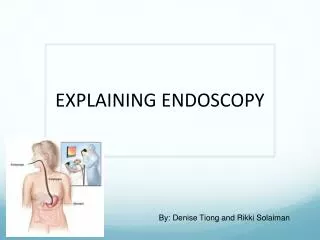
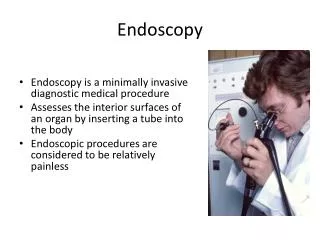
Endoscopy is a vital medical procedure used for diagnostics and minor surgeries within the body. It involves taking images, samples, and performing biopsies to diagnose conditions such as stomach ulcers, irritable bowel syndrome, internal bleeding, and cancer. The evolution of endoscopy dates back to 1806, with significant advancements in technology leading to the present state, which includes flexible tubes with fiber optic lights and camera lenses. Despite its advantages like shorter recovery time, risks such as perforation and infection remain. The future promises innovations like disposable and capsule endoscopes.

Endoscopy
E N D
Presentation Transcript
By Kelsey Matthews Endoscopy
Purpose • Diagnostics- take images, samples, biopsies • Diagnosis of conditions like stomach ulcers, irritable bowel syndrome, internal bleeding and cancer. • Surgery- simple surgeries and cuts inside the body
Early History • 1806- long rigid tube, light on the end to illuminate a body cavity or organ • 1945- brighter light to add enough visibility for image documentation • 1960s- fiber optics introduced, images transmitted, more flexible, steerable end • 1986- the magnification and projection of images onto television screens
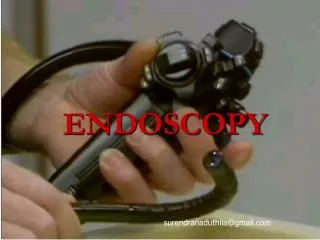
Current State of Art • a long, flexible tube, • a fiber optic light • a camera lens • another channel that can be used for other medical instruments if necessary
State of art cont. • Entrance: anus, the throat, the urethra, or a small incision in the skin • 15-60 minutes long • Outpatient procedure
Advantages • Short recovery time, little to no post-op pain • More precision for surgeon • Little blood, no need for stitches
Disadvantages • Slight chance for perforations and other damage to organs • Possibility of infection at sight of incision or along path of endoscope
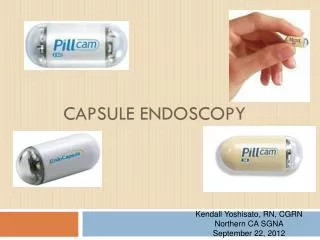
Future • Disposable endoscope • Capsule endoscope • 3D endoscopy for imaging and measurements
Bibliography • The Better Health Channel <www.betterhealth.vic.gov.au/BHCV2/bhcarticles.nsf/pages/Endoscopy?open>. • Wikipedia: Endoscopy <http://en.wikipedia.org/wiki/Endoscopy>. • Medical News Today <http://www.medical newstoday.com/articles/153737.php> • Roberts-Thomson IC, Singh R, Teo E, Nguyen NQ, Lidums I. The future of endoscopy. J GastroenterolHepatol. 2010 • Hart R, Classen M. Complications of diagnostic gastrointestinal endoscopy. PubMed. 1990, 22(5):229-233