Download
1 / 9
90 likes | 188 Views
This week's homework involves your first Reader’s-Writer’s Log entry, essential for showing your understanding and reactions to what you read. You will engage in silent sustained reading, critically analyze your chosen book, and respond to it in writing for assessment. Active participation counts as 25% of your course grade, emphasizing the importance of daily effort. Additionally, you will have the opportunity to express your seating preference for optimal learning. Complete all assignments thoughtfully for a successful outcome!

E N D
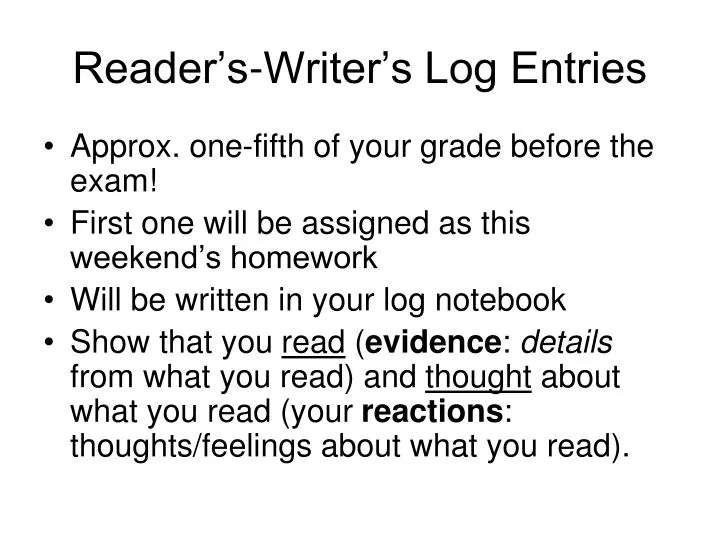
Reader’s-Writer’s Log Entries • Approx. one-fifth of your grade before the exam! • First one will be assigned as this weekend’s homework • Will be written in your log notebook • Show that you read (evidence: details from what you read) and thought about what you read (your reactions: thoughts/feelings about what you read).
“Kick-off” 8/27 • Silently read “Honesty is the Best Policy!” – on the white sheet. You will also receive a blue sheet with the same information. Sign and print your nameat the bottomofboth the white and the blue copies. Keep these out on your desk. • Then, take out your book that you brought for independent reading.
Daily Grade: “Good Faith Participation” (GFP) • Daily effort – crucial to learning that lasts • 25% of course grade before Final Exam AND • will also count as a test grade at progress report and report card times • To do well: Do your best work every day and look for opportunities to go “above and beyond” basic requirements.
Silent Sustained Reading • You must read silently. • No writing during SSR time • Head up • You may sometimes be asked to write about what you read after SSR time.
On loose-leaf paper (half-sheet?), write your response: “What have you chosen as your independent reading for this class? Why did you choose it? Explain.” You will NOT be required to share this with other students.
Reader’s-Writer’s Log Entries • Approx. one-fifth of your grade before the final exam! • First one will be assigned as this weekend’s homework • Will be written in your log notebook • Show that you read (evidence: details from what you read) and thought about what you read (your reactions: thoughts/feelings about what you read).
Editorial Essay Evidence Nonfiction Prose Speeches Topic 8. Author’s argument 9. Informational materials 10. Journals, diaries, and letters 11. Use of logic 12. Author’s rhetorical purpose 13. Rhetorical strategies 14. Satire Listen well and follow directions to create the graphic organizer before you copy these terms. Then, define or provide an example of the three terms for which you can make the best guesses. Use pencil.
Editorial Essay Evidence Nonfiction Prose Speeches Topic 8. Author’s argument 9. Informational materials 10. Journals, diaries, and letters 11. Use of logic 12. Author’s rhetorical purpose 13. Rhetorical strategies 14. Satire Write down definitions andexamples.
Someday, Ms. Powers might create a new seating chart for this class. Here is your chance to give some input about which area of the room might help you to learn best. Imagine that the room in divided into 4 sections (see diagram on your left-hand side of the board). On loose-leaf paper (half-sheet?): write the letter of your first choice and explain (give reasons) why this would be a good location for your seat. (Be persuasive!) Then, write the letter of your second choice.