Overview of the Six Kingdoms of Life: Characteristics and Classifications
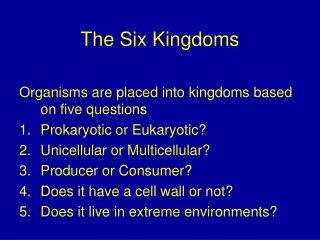
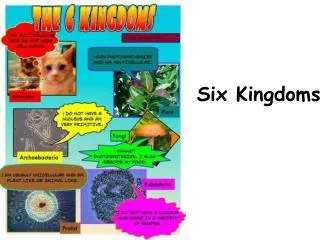
This text provides a detailed overview of the Six Kingdoms of Life, classifying organisms based on their cellular structure, nutrition, and other defining characteristics. The kingdoms include Animalia, Plantae, Fungi, Protista, Eubacteria, and Archaebacteria. It explains key terms such as autotrophic and heterotrophic organisms, unicellular and multicellular forms, as well as prokaryotic and eukaryotic classifications. The information serves as an educational resource for understanding biological diversity and the evolutionary relationships among different life forms.

Overview of the Six Kingdoms of Life: Characteristics and Classifications
E N D
Presentation Transcript
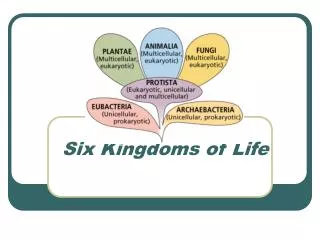
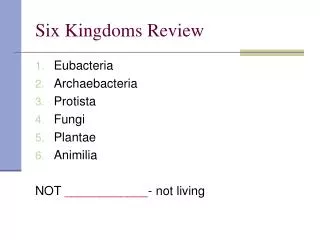
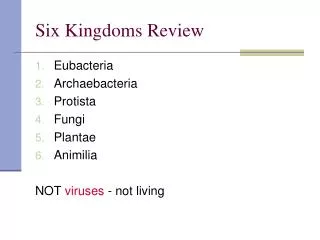
Key terms • Autotrophic – Producer -makes its own food • Heterotrophic – Consumer -can’t make its own food – consumes other organisms • Unicellular – one cell • Multicellular – many cells • Prokaryote – has no nucleus or membrane bound organelles • Eukaryote – has nucleus and organelles
Kingdom Animalia (Animals) • Multicellular • Heterotrophs consume food • Feeds on plants or animals • Moves • Eukaryotic • No cell walls
Multicellular Autotrophic Photosynthesis Cell walls made of cellulose Eukaryote Kingdom Plantae (Plants)
Kingdom Fungi • Multicellular, except yeast • Absorptive heterotrophs (digest food outside their body and then absorb it) • Cell walls made of chitin • Can’t move • Decomposers • Eukaryote
yeast Giant puffballs range from golf ball size to as large as a watermelon
Unicellular (most) and multicellular Food: autotrophic or heteroprophic (euglena does both) Moves Eukaryotes Some have cell walls w/cellulose - some don’t have cell walls Kingdom Protista (Protist)
Kingdom Eubacteria Eubacteria, some of which cause human diseases, are present in almost all habitats on earth. Unicellular Prokaryote some heterotropic – decomposers some autotophic some move Cell walls w/peptidoglycan Many bacteria are important environmentally and commercially.
Kingdom Archeabacteria Archaeabacteria live in harsh environments and may represent the first cells to have evolved. Some get energy through chemosynthesis Cell walls without pepidoglycan Prokaryote Unicellular
Archaeabacteria in Deep-Sea Hydrothermal Vent Environments use chemosynthesis to obtain energy.
Finding Archaeabacteria : The hot springs of Yellowstone National Park, USA, were among the first places Archaea were discovered. The coloring comes from the massive amount of archaebacteria (which are chemo-synthesizers)
Archaebacteria In 1983, scientists took samples from a spot deep in the Pacific Ocean where hot gases and molten rock boiled into the ocean form the Earth’s interior. To their surprise they discovered unicellular (one cell) organisms in the samples. These organisms are today classified in the kingdom, Archaebacteria.
What is a Cladogram? • Diagram showing how organisms are related based on shared characteristics such as feathers, hair, or scales