World War I Overview: Causes, Alliances, Battles
420 likes | 523 Views
Learn about the causes, alliances, key battles, and outcomes of World War I that led to the Treaty of Versailles and its impact on World War II. Understand the complexities of mutual defense alliances, imperialism, nationalism, militarism, and the assassination of Archduke Franz Ferdinand. Explore the web of alliances among European powers. Discover the new military technologies and fighting tactics employed during WWI. Delve into the repercussions of the war, the Treaty of Versailles and the U.S. involvement.


World War I Overview: Causes, Alliances, Battles
E N D
Presentation Transcript
Format of Test • 10 Matching • 10 Fill in the Blank (NO word bank) • 5 Multiple Choice • 5 True/ False • 4 Short Answer
Unit Concepts • Causes of the War/ US involvement • New military technology and fighting tactics • Sequences of events and battles • Outcomes/Repercussions of the War and the Treaty of Versailles (how did this lead to WWII)
Causes of the Conflict • Mutual Defense Alliances- complex system of alliances brought entire continent into war • Imperialism- struggle for colonies in Africa and Asia • Nationalism- struggle for power in Europe • Militarism- intense arms buildup before war • Assassination of Archduke Franz Ferdinand- the tipping point
Web of Alliances What is an alliance? Why is it formed?
Web of Alliances • European powers made alliances over the years for mutual defense and to maintain the balance of power on the continent. • In an alliance, you are bound to defend your ally if they are attacked. • Once fighting started, the war spread across the continent as countries were obligated to fight with their allies.
*Alliances* Central Powers/ Triple Alliance Allied Powers/ Triple Entente Great Britain France Russia • Austria-Hungary • Ottoman Empire • Bulgaria
Allied Powers • United Kingdom, France, and the Russian Empire. • Other members: Belgium, Serbia, Italy, Japan, Greece, and Romania. • The United States would later join on the side of the Allies.
Central Powers • German Empire, Austro-Hungarian Empire, Ottoman Empire, and the Kingdom of Bulgaria.
Web of Alliances • After the Archduke Franz Ferndinand was killed by a Serbian/Bosnian revolutionary a chain of war declarations occurred. • July 28 Austria -> Serbia • August 1 Germany -> Russia • August 3 Germany -> France
Imperialism European countries were all trying to colonize Africa which set them up for conflict.
*Nationalism* • What is Nationalism? • Intense pride for one’s homeland. • People who belong to a nation should have their own country and govt.
Militarism • Due to imperialism many European countries began building up arms. • They were somewhat already prepared for war. • Anglo-German naval race
The Assassin • Gavrilo Princip • *Nationalist* • In Sarajevo
Peace Movement The Home Front • Women divided, but most active • Germans, Irish • Religious pacifists • Intellectuals
American Involvement (or lack thereof) • The US became *isolationalist.* • What do you think this means? • *Why would the US want to be isolated from conflict?*
American Isolationalism • Close ties to England and France. • President Wilson’s cabinet overwhelmingly supported Great Britain. • British propaganda • Economy • trading partners with the Allies • loans to the Allies.
American Involvement • *Lusitania* • British passenger ship • Sunk by *German U-Boats* • Sussex • French passenger ferry • Led to *Sussex Pledge* • Zimmerman Note/ Telegram • Germany encouraged Mexico to turn against US
American Involvement • Germany resumes unrestricted sub. warfare. • Feb. 1917, Sunk 4 American merchant ships • US declared war against Germany 2 months later • Building up the Military • Selective Service • African Americans, segregated units • 1st war for women
American Involvement • Organizing Industry • Co-op between Big Business and the Govt. • War Industries Board • Victory Gardens • Daylight Savings time • Liberty and Victory Bonds
American Involvement • Mobile Workforce • National War Labor Board (NWLB) • More women • Stopped flow of immigrants, sought out A.A. instead, led to the “Great Migration” • Mexican Americans moved to S.W.
American Involvement • Public Support • Committee on Public Information (CPI) • Espionage • Mistreatment of German Americans, radical labor activists, socialists, pacifists, etc. • Schneck v. the United States, limited speech
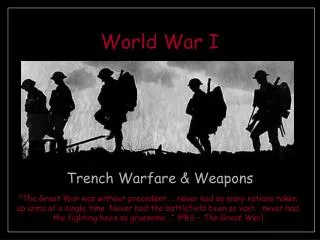
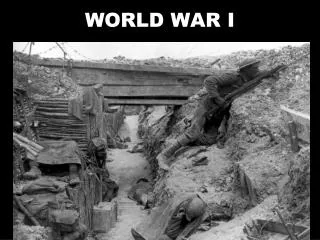
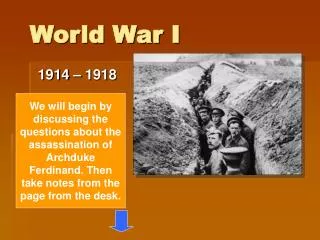
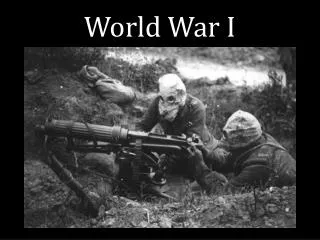
Techniques of WWI • Combat in WWI • Trench warfare • “No man’s land” • Moved only a few miles on either side for during the entirety of the war • *Attrition*
*New Technologies of WWI* • Poison gas • German • Chlorine gas • Tanks • British
*New Technologies of WWI* • Airplanes • British • Machine guns
Russians • 1917, Lenin overthrew the Russian govt. to set up a Communist govt. • He pulled Russia out of the war to focus on establishing a communist state.
Details about the War • *Eastern Front* • *Western Front* • Outline on map • *Eastern Front* • *Western Front* • Outline on map
Americans in the War • *Monroe doctrine* kept us out of the war until the last year. • American “Doughboys” boosted the morale of the Allied forces. • Convoys (proposed by a US admiral) to bring troops and merchant ships • March 1918, Germany attacked the Western Front (Paris)
Americans in the War • Sept. 1918, American General Pershing planned the most massive attack in US history at the time. • Nov. 1918, Germany signed an armistice (cease-fire)
Outcomes • *Big Four* • Allied Leaders who met at the Paris Conference • US, Woodrow Wilson • Britain, David Lloyd George • Italy, Vittorio Orlando • France, Georges Clemenceau
Outcomes- Flawed? • Jan. 1919, Allied nations met at Paris • *Wilson brought his 14 Points.* • Addressed the “principle of justice to all people and nationalities” • Free trade and disarmament • Open diplomacy • Central powers must evacuate all countries invaded • *League of Nations* created (US did NOT join)
Outcomes- Flawed? • The other Allieds believe that the 14 pts. were too lenient towards Germany. • Treaty of Versailles • Stripped Germany of its armed forces • Made it pay *reparations* (war damages to Allies.)
Outcomes- Flawed? • 1) It limited the German Army to 100,000 men, demilitarized much of western Germany, and forbade the German ownership of military aircraft, poison gas, or any naval units. • 2) Huge war reparations were demanded of the Germans. • 3) German Representatives thought that the Treaty was laid out by Wilson which signified US Betrayal.
Outcome- Flawed? • 4) Occupation • 5) Put the sole blame for the war on Germany • .6) The German Representative who signed the Treaty, Fredrick Ebert, was Jewish. Post-WWI, growing anger regarding the Treaty and economic downturn (Most bankers were Jewish) led to a rise in Anti-Semitism.
*New Countries after WWI* • Russia renounced all claims to: • Estonia • Finland • Lativia • Lithuania • Poland
Outcomes back in the US • Economy • Racial Unrest • Red Scare • End of Progressivism