Download
1 / 39
390 likes | 536 Views
This chapter explores how elements are organized in the periodic table, beginning with Mendeleev's initial arrangement based on atomic mass, leading to the modern structure employing atomic numbers. It details the classification of elements into metals, nonmetals, and metalloids, emphasizing their properties and locations. Additionally, it distinguishes between periods and groups, highlighting how elements within a group share chemical properties and periodic trends. Follow along as we decode the table, review group characteristics, and examine element behaviors throughout the periodic system.

E N D
The Periodic Table Chapter 12 Material on Midterm
Section 1: Arranging the Elements • Objectives • Describe how Mendeleev arranged elements in the first periodic table • Explain how elements are arranged in the modern periodic table • Compare metals, nonmetals, and metalloids base on their properties and on their location in the periodic table • Describe the difference between a period and a group
Section 1: Arranging the Elements • Placement Pattern • What is the best way to arrange things?
Section 1: Arranging the Elements • Discovering a Pattern • Mendeleev discovered that the elements discovered had a pattern to them
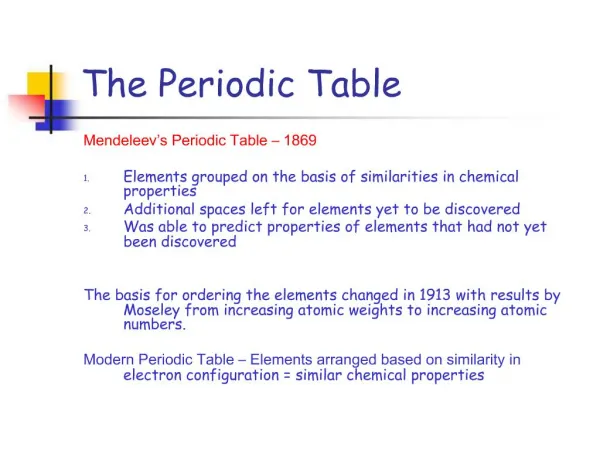
Section 1: Arranging the Elements • Mendeleev arranged atoms by increasing atomic mass • Saw that there was a periodic trend • Periodic describes something that occurs or repeats at regular intervals • Organized them in a table • FIRST PERIODIC TABLE OF THE ELEMENTS • Some holes in the table
Section 1: Arranging the Elements • Predicting Properties of Missing Elements • Some gaps in the pattern • Was able to predict the properties • Eka-aluminum….after aluminum
Section 1: Arranging the Elements • Changing the arrangement • Moseley realized it made more sense to use the atomic number instead of the atomic mass • The periodic law is the law that states that the repeating chemical and physical properties of elements change periodically with the atomic numbers of the elements
Section 1: Arranging the Elements • The Periodic Table and Classes of Elements • We break elements into three major groups • Metals • Nonmetals • Metalloids
Section 1: Arranging the Elements • Metals • Most elements • Left of the zigzag line on the periodic table • Most are solid at room temperature (Hg exception) • Properties • Shiny • Malleable • Ductile • Good conductors
Section 1: Arranging the Elements • Nonmetals • Right of the zigzag line • Many are gases at room temperature • Not malleable • Not ductile • Not shiny • Poor conductors
Section 1: Arranging the Elements • Metalloids • Aka semiconductors • Border zigzag line • Have some properties of metals • Some properties of nonmetals
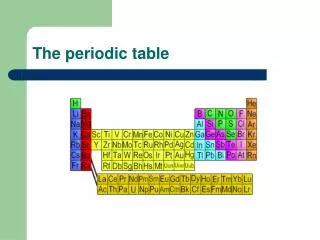
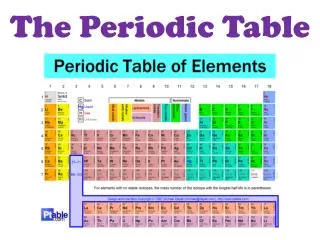
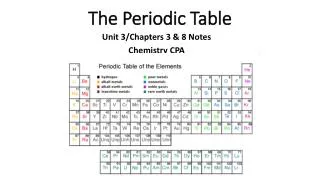
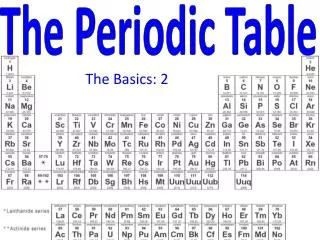
Section 1: Arranging the Elements • Decoding the Periodic Table
Section 1: Arranging the Elements • Horizontal • A period is a horizontal row of elements on the periodic table • Properties repeat as you go along a period • Vertical • A group is a vertical column of elements in the periodic table • Elements in a group share chemical properties
Section 1: Arranging the Elements • Section Review • Please answer the objectives on your objective summary sheet • Describe how Mendeleev arranged elements in the first periodic table • Explain how elements are arranged in the modern periodic table • Compare metals, nonmetals, and metalloids base on their properties and on their location in the periodic table • Describe the difference between a period and a group
Section 2: Grouping the Elements • Objectives • Use the periodic table to gain information about various elements • Explain why elements in a group often have similar properties • Describe the properties of the elements in the groups of the periodic table
Section 2: Grouping the Elements • We will discuss the following groups: • Group 1: Alkali Metals • Group 2: Alkaline Earth Metals • Groups 3-12: Transition Metals • Group 13: Boron Group • Group 14: Carbon Group • Group 15: Nitrogen Group • Group 16: Oxygen Group • Group 17: Halogens • Group 18: Noble Gases • Hydrogen
Section 2: Grouping the Elements • Group 1: Alkali Metals • The alkali metals are the elements of Group 1 of the periodic table (lithium, sodium, potassium, rubidium, cesium, and francium) • Group contains: metals • Electrons in outer level: 1 • Reactivity: Very reactive • Other shared properties: softness, color of silver, shininess, low density
Section 2: Grouping the Elements • Group 2: Alkaline Earth Metals • The alkaline earth metals are the elements of Group 2 of the period table (beryllium, magnesium, calcium, strontium, barium, and radium) • Group contains: metals • Electrons in outer level: 2 • Reactivity: very reactive, but less reactive than alkali metals • Other shared properties: color of silver, higher densities than alkali metals
Section 2: Grouping the Elements • Groups 3-12: Transition Metals • No individual names • Varied in properties • Group contains: metals • Electrons in outer level: 1 or 2 • Reactivity: less reactive than the alkaline earth metals • Other shared properties: shininess, good conductors, higher densities and melting points than Groups 1 and 2 (except Hg)
Section 2: Grouping the Elements • Lanthanides and Actinides • The two bottom rows • Row 1: starts with lanthanum--lanthanides • Shiny, reactive metals • Row 2: starts with actinium—actinides • Radioactive, unstable elements • Any after 94—not found naturally
Section 2: Grouping the Elements • Group 13: Boron Group • The Boron Group contains elements from group 13 of the periodic table (boron, aluminum, gallium, indium, and thallium) • Group contains: one metalloid and four metals • Electrons in the outer level: 3 • Reactivity: reactive • Other shared properties: solids at room temperature
Section 2: Grouping the Elements • Group 14: Carbon Group • The carbon group contains elements from group 14 of the periodic table (carbon, silicon, germanium, tin, lead, flerovium) • Group contains: one nonmetal, two metalloids, and three metals • Electrons in the outer level: 4 • Reactivity: varies among the elements • Other shared properties: solids at room temperature
Section 2: Grouping the Elements • Carbon: nature’s most important element • Found in carbohydrates, proteins, fats, and nucleic acid (DNA) • Germanium and silicon are used as conductors in computer chips
Section 2: Grouping the Elements • Group 15: Nitrogen Group • The Nitrogen group contains elements from group 15 of the periodic table (nitrogen, phosphorus, arsenic, antimony, bismuth, ununpentium) • Group contains: two nonmetals, two metalloids, and two metals • Electrons in the outer level: 5 • Reactivity: varies among the elements • Other shared properties: solids at room temperature (except for nitrogen)
Section 2: Grouping the Elements • Group 16: Oxygen Group • The Oxygen group contains elements from group 16 of the periodic table (oxygen, sulfur, selenium, tellurium, polonium, livermorium {name pending}) • Group contains: three nonmetals, one metalloid, and two metals • Electrons in the outer level: 6 • Reactivity: reactive • Other shared properties: all but oxygen are solid at room temperature
Section 2: Grouping the Elements • Group 17; Halogens • The halogens are elements of group 17 of the periodic table (fluorine, chlorine, bromine, iodine, astatine, ununseptium); halogens combine with most metals to form salts • Group contains: nonmetals • Electrons in the other level: 7 • Reactivity: very reactive • Other shared properties: poor conductors, violent reactions with alkali metals to form salts, never in uncombined form in nature
Section 2: Grouping the Elements • Group 18: Noble Gases • The noble gases are elements of group 18 of the periodic table (helium, neon, argon, krypton, xenon, radon, and ununoctium); noble gases are unreactive • Group contains: nonmetals • Electrons in the outer level: 8 (except helium, which has 2) • Reactivity: unreactive • Other shared properties: colorless, odorless gases at room temperature
Section 2: Grouping the Elements • Hydrogen • The properties of hydrogen do not match any other group (the loner element) • We stick him in group 1 based on outer electrons • Electrons in outer level: 1 • Reactivity: reactive • Other properties: colorless, odorless gas at room temperature; low density, explosive reactions with oxygen
Section 2: Grouping the Elements • Section Review • Please answer the objectives on your objective summary sheet • Use the periodic table to gain information about various elements • Explain why elements in a group often have similar properties • Describe the properties of the elements in the groups of the periodic table