Understanding Composite Video: Signals, Interference, and Compatibility
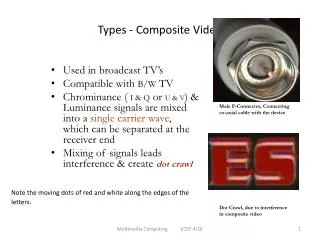
Composite video is a format used in broadcast television, where chrominance (color) and luminance (brightness) signals are combined into a single carrier wave. This approach allows compatibility with black-and-white TVs but can lead to interference issues, such as dot crawl. Dot crawl manifests as moving dots of color along the edges of letters in the image, caused by the mixing of signals. The male F-connector is used to connect coaxial cables to devices. Understanding these technical aspects is essential for multimedia computing.

Understanding Composite Video: Signals, Interference, and Compatibility
E N D
Presentation Transcript
Types - Composite Video • Used in broadcast TV’s • Compatible with B/W TV • Chrominance ( I & Q or U & V) & Luminance signals are mixed into a single carrier wave, which can be separated at the receiver end • Mixing of signals leads interference & create dot crawl Male F-Connector, Connecting co-axial cable with the device Note the moving dots of red and white along the edges of the letters. Dot Crawl, due to interference in composite video Multimedia Computing (CSIT 410)