Download

1 / 14
200 likes | 358 Views
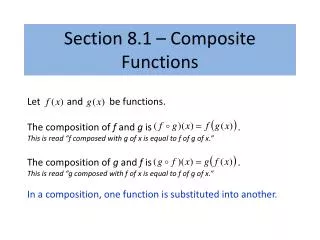
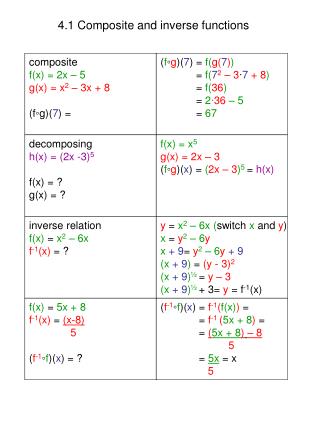
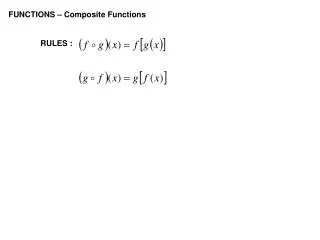
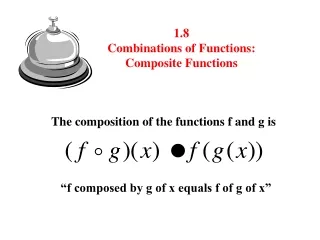
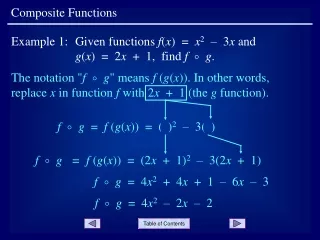
Dive into the concept of composite functions and learn how they combine multiple functions into a single entity. A composite function is formed when the output of one function (g(x)) becomes the input for another (f(x)). This guide explores how to express composite functions and illustrates this with practical examples. You'll see how different sequences of operations lead to different results, such as f(g(x)) vs. g(f(x)). By applying formulas and specific values, you will gain a clearer understanding of how to work with composite functions effectively.

E N D
What is to be Learned • What a composite function is • How to express a composite function
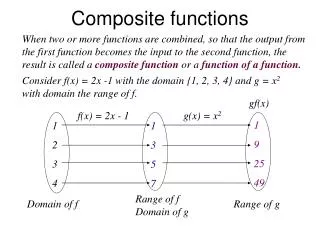
Definition • A number (or letter) is affected by more than one function
f(x) = 3x and g(x) = x2 Combining these: Multiply by 3, then square or Square, then multiply by 3 Not the same! Multiply by 3 Square
f( ) ? f(4) f( ) f(4) 16 f(x) = x2 f(4) = 16 f(16) = 162
With Formulas f(x)= 2x + 1 g(x) = 4x Composite functions f(g(x)) or f(g(x)) g(f(x)) Change this
f(x)= 2x + 1 g(x) = 4x Composite functions f(g(x)) or f(g(x)) g(f(x)) Change this
f(x)= 2x + 1 g(x) = 4x Composite functions f(g(x)) or f(g(x)) = f(4x) g(f(x)) Change this
f(x)= 2x + 1g(x) = 4x Composite functions f(g(x)) or f(g(x)) = f(4x) g(f(x)) Change this = 2(4x) + 1 = 8x + 1
f(x)= 2x + 1 g(x) = 4x Composite functions f(g(x)) or f(g(x)) = f(4x) g(f(x)) Change this g(f(x)) = 2(4x) + 1 = 8x + 1
f(x)= 2x + 1 g(x) = 4x Composite functions f(g(x)) or f(g(x)) = f(4x) g(f(x)) g(f(x)) = g(2x + 1) = 2(4x) + 1 = 8x + 1
f(x)= 2x + 1g(x) = 4x Composite functions f(g(x)) or f(g(x)) = f(4x) g(f(x)) g(f(x)) = g(2x + 1) = 4(2x +1) = 2(4x) + 1 = 8x + 1 = 8x + 4
Composite Functions Combination of more than one function. If f(x) = 4x and g(x) = x2 g( f(3) )? f(3) = 12 so g( f(3) ) = g (12 ) = = 144 122
f(x)= 3x + 4 g(x) = 2x Composite functions f(g(x)) or f(g(x)) = f(2x) g(f(x)) g(f(x)) = g(3x + 4) = 2(3x +4) = 3(2x) + 4 = 6x + 4 = 6x + 8