Download
1 / 18
180 likes | 322 Views
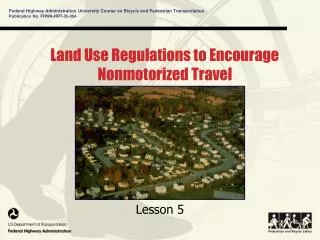
Lesson 5 of FHWA-HRT-05-094 explores how zoning and subdivision regulations can promote nonmotorized travel. It covers essential elements of zoning, including both residential and commercial development standards. Key topics include building orientation, streetscape design, internal circulation, and pedestrian-friendly connections. The lesson emphasizes the importance of form-based codes, design strategies for low-vehicle-speed streets, and the role of developers in fostering walkability and accessibility. By implementing thoughtful regulations, communities can create environments that support cycling and walking.

E N D
Publication No. FHWA-HRT-05-094 Land Use Regulations to Encourage Nonmotorized Travel Lesson 5
Lesson Outline • General elements of zoning and subdivision regulation. • Development standards for commercial areas. • Development standards for residential areas. • Elements of a form-based code.
General Elements of Zoning and Subdivision Regulation • Subdivision layout. • Cul-de-sacs. • Future extension of streets. • Staged implementation. • Internal circulation.
Commercial Development Standards • Building orientation and facades. • Onsite circulation. • Access between developments. • Parking lots.
Building Orientation Source: PBIC (Dan Burden), www.pedbikeimages.org
Onsite Circulation Source: PBIC (Dan Burden), www.pedbikeimages.org
Development Connections Source: PBIC (Dan Burden), www.pedbikeimages.org
Creative Parking Lot Design Source: PBIC (Dan Burden), www.pedbikeimages.org
Residential Design Standards • Connectivity. • Short cuts for pedestrians and bicyclists. • Pedestrian- and bicycle-oriented streetscapes. • Streets with low vehicle speeds (<32 km/h (<20 mi/h)).
Interconnectivity Source: PBIC (Dan Burden), www.pedbikeimages.org
Cul-de-sacs Source: PBIC, www.pedbikeimages.org
Trail Connections Source: PBIC (Dan Burden), www.pedbikeimages.org
Rear-Access Parking Source: PBIC (Dan Burden), www.pedbikeimages.org
Purpose of a Form-Based Code • To establish a basic prescription for good public space along a street. Source: Arlington County Form Based Code
Elements of a Form-Based Code • Building placement (height, distance from street, width). • Streetscape standards. • Architectural standards. • Standards for other public spaces—civic greens, pedestrian walkways, etc.
Lesson Summary • Zoning and planning regulations can be effective tools in encouraging pedestrian and bicycle travel. • Developers play a key role in accommodating and encouraging nonmotorized travel. • There are a variety of strategies for achieving good design in residential and commercial areas.