Using a Single-Nucleotide Polymorphism to Predict Bitter-Tasting Ability
140 likes | 240 Views
Carolina Kit timeline for procedures and lab tasks using Single-Nucleotide Polymorphisms (SNPs) to predict bitter-tasting ability. The lab includes DNA isolation, amplification, gel electrophoresis, and bioinformatics analysis. Detailed instructions for each step are provided along with resources and references. Students will learn about SNPs, genotypes, phenotypes, and the TAS2R38 locus. The lab culminates in analyzing results, drawing gel bands, conducting bioinformatics analysis, and understanding the relationship between genotype and phenotype in bitter taste perception.


Using a Single-Nucleotide Polymorphism to Predict Bitter-Tasting Ability
E N D
Presentation Transcript
Using a Single-Nucleotide Polymorphism to Predict Bitter-Tasting Ability Carolina Kit
Timeline Thursday—Lecture, volunteer aliquot Monday—procedures quiz, Bioinformatics HW: Bioinformatics (use website, not packet) Tuesday—isolate DNA cells, amplify DNA (PCR) Wednesday—Volunteer pour gels Thursday—digest samples, run gel, photograph gel Tuesday—Lab write-up due (after break)
Write-up • Annotate handout • Data draw a gel and mark each banding site, staple picture to lab that you turn in to me • Results and Discussion—answer all parts • Bioinformatics worksheet
Background Information • http://bioinformatics.dnalc.org/ptc/animation/ptc.html read introduction
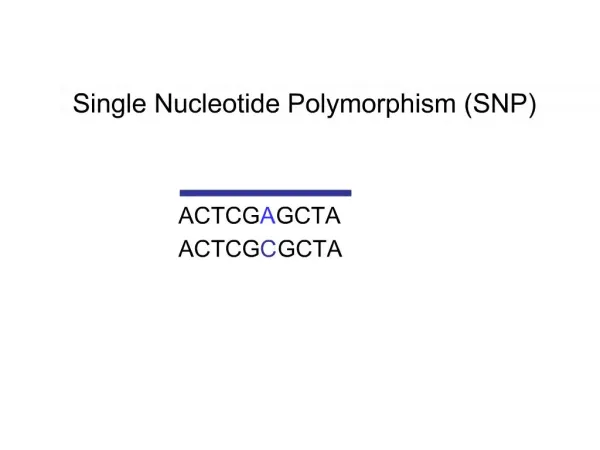
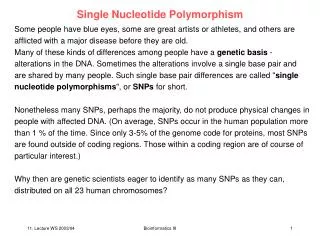
Single nucleotide polymorphism DNA Science textbook: page 296-297 • Point mutation • Most mutations are rare in a population, so to be helpful, SNPs must have a population frequency of 1% • A region of linkage is called haploblock because it is inherited without recombination like haploid in mDNA • A set of SNPs, markers, within the haploblock are inherited as a haplotype. • Different populations inherit different SNPs with the haploblock • This info. is great for linkage studies • The hope is to make a map, find disease genes in populations of unrelated people
Genotype and Phenotypes • The TAS2R38 polymorphism was specifically selected to demonstrate the relationship between genotype and PTC-tasting phenotype, because it has no known relationship to disease states or sex determination. • TAS2R38 alleles are inherited in a Mendelian fashion and can give indications about family relationships.
Prep. For lab--SNP Week before • Label tubes • Pre-set thermo-cycler By Tuesday • 10 mL of .9% NaCl solution (.9g NaCl/100ml water) in 15 mL plastic tube (15) • 100 uL 10% chelex into 1.5mL tube (15) • 22.5uL of PTC primer/loading dye (30) • 10uL of Restriction enzyme HaeIII (15) • 20uL pBR322/BstNI marker (8) • paper cups • TBE 20x dilute to 1x to use (150mL TBE with 2850mL dwater) Tuesday • Ice buckets with ice Wednesday • Pour 2% gels, add ethidium bromide (200ng/mL final or 1uL of 10mg/mL stock in gel prepared from 50mL), 6 well comb, TBE buffer(10 grams agarose add up to 500mL TBE buffer) • Prepare UV trans. and camera By Thursday • Set-up water bath 37 degrees
Preparing gels • ___ grams agarose • Add up to ___mL buffer • Melt in microwave, let cool • Set up trays—use 6 well comb • Add 1uL ethidium bromide/50uL of solution • Pour about 30-50mL into each tray
Protocol • http://bioinformatics.dnalc.org/ptc/animation/ptc.html review flow chart
Lab Day 1Part I: isolate DNA Part II:PCR • We are doing cheek cells • Work with a partner in your group (15 sets in the class) • we will use the heat block at set 9 • No Mineral oil for PCR • I will store your PCR samples in the freezer after PCR
Lab Day 2Part III: Digest Part IV: electrophoresis • Make sure to label with a “D” and “U” • At step 5, use the water bath instead of thermo-cycler • Skip step 9, we already added ethidium bromide • Test your bitter taste
Gel loading • Marker • Partner set 1-U • Partner set 1-D • Partner set 2-U • Partner set 2-D • Empty Make sure to record what is in each lane in your lab notebook
results • http://bioinformatics.dnalc.org/ptc/animation/ptc.html review results section
Bioinformatics • http://bioinformatics.dnalc.org/ptc/animation/ptc.html Use website directions as it is most updated • Complete the worksheet for homework