Understanding Survey Research: When and How to Use Surveys Effectively
This document explores the fundamentals of survey research, detailing when to use surveys to gauge behavior, attitudes, beliefs, and expectations of participants. It explains the logic behind surveys, including key concepts like measures of variables and the importance of respondent uniformity. Step-by-step instructions on conducting surveys and designing questionnaires are presented, along with common pitfalls in survey question writing. Additionally, the document addresses sensitive questions and various types of surveys, comparing advantages and disadvantages to optimize data collection.

Understanding Survey Research: When and How to Use Surveys Effectively
E N D
Presentation Transcript
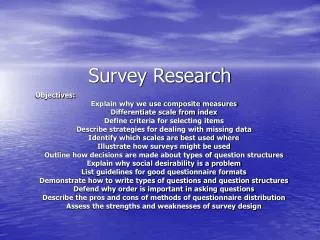
Survey Research Soc 102
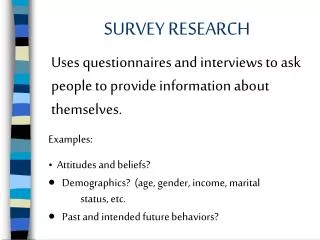
When to Use a Survey Behavior Attitudes/beliefs/opinions Expectations Self-classification Knowledge 2
The Logic of Survey Research • What Is a Survey? • Measures of variables, usually all respondents answer the same questions • Conducting a Survey • Interview schedule • Questionnaire (self-administered) 3
Constructing the Questionnaire • Questionnaire Design Issues • Length of Survey or Questionnaire • Question Order or Sequence • Agree/Disagree, Rankings, or Ratings • Open versus Closed Questions • Open and closed-ended questions • Nonattitudes and the Middle Positions 13
Types of Surveys • Mail/self-administered questionnaire • Advantages • Disadvantages • Web surveys • Advantages • Disadvantages 16