Enhancing Fault Tolerance in Exascale Systems: Algorithm-Based Approaches
As the number of cores in systems increases, the Mean Time To Failure (MTTF) decreases, posing severe challenges in future exascale computing environments. Our research aims to address fail-stop failures without deploying backup nodes, focusing on algorithm-based fault tolerance. We explore methods like Minimum Data Intersection, Passive Replication, and summary-based techniques in developing fault-tolerant parallel data-intensive algorithms. Our experimental results reveal the impact of summary exchange frequency on total execution time amid varying failures, offering promising solutions for resilient computing.

Enhancing Fault Tolerance in Exascale Systems: Algorithm-Based Approaches
E N D
Presentation Transcript
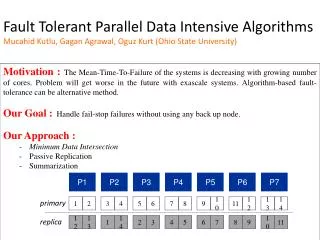
Motivation : The Mean-Time-To-Failure of the systems is decreasing with growing number of cores. Problem will get worse in the future with exascale systems. Algorithm-based fault-tolerance can be alternative method. • Our Goal : Handle fail-stop failures without using any back up node. • Our Approach : • Minimum Data Intersection • Passive Replication • Summarization Fault Tolerant Parallel Data Intensive AlgorithmsMucahidKutlu, GaganAgrawal, Oguz Kurt (Ohio State University) P1 P2 P3 P4 P5 P6 P7 primary 1 2 3 4 5 6 7 8 9 10 11 12 13 14 replica 12 13 1 14 2 3 4 5 6 7 8 9 10 11
Recovery Scenario File System Master P1 P2 P3 P4 D1 D2 D3 D4 D5 D6 D7 D8 D6 D7 D1 D8 D2 D3 D4 D5 Experimental Results Impact of Summary Exchange Frequency in Apriori: Varying Number of Failures Total Execution Time that Changes with the Number of Failures