Exploring Limits and Derivatives of Logarithmic Functions
This document provides a thorough exploration of finding limits and derivatives related to logarithmic functions. It discusses various scenarios where limits exist and how to determine them, alongside different derivative applications. Through examples, the text highlights the process of differentiating logarithmic functions and illustrates the concept of e as a limit. Additionally, it covers important definitions and forms of limits, aiding in the understanding of the rules governing logarithmic differentiation. Homework exercises are also included for practice.

Exploring Limits and Derivatives of Logarithmic Functions
E N D
Presentation Transcript
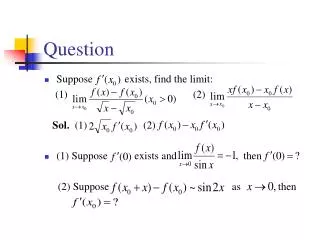
Question • Suppose exists, find the limit: (1) (2) Sol. (1) (2) • (1) Suppose exists and then (2) Suppose as then
Question Suppose exists and find the limit The solution is Sol.
Derivatives of logarithmic functions • The derivative of is • Putting a=e, we obtain
Example Ex. Differentiate Sol. Ex. Differentiate Sol.
Question Find if Sol. Since it follows that Thus for all
Example Find if Sol. Since it follows that and by definition, Thus for all x
Question Find if (a) (b) (c) Sol. (a) (b) (c)
The number e as a limit • We have known that, if then • Thus, which by definition, means • Or, equivalently, we have the following important limit
Other forms of the important limit • Putting u=1/x, we have • More generally, if then
Question Suppose exists and find the limit The solution is Sol. Let then
Question Discuss the differentiability of and find Sol. does not exist
Homework 6 • Section 3.6: 46, 49, 50 • Section 3.7: 16, 20, 34, 35, 39, 40, 63 • Section 3.8: 41, 45, 48