Tissue Types
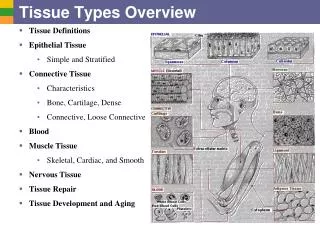
This overview details the various types of tissues in the body, highlighting their structures and functions. It covers histological examination methods such as teased, smeared, and thin section samples, along with staining techniques to enhance specimen contrast. The four primary tissue types—muscle, epithelial, connective, and nerve—are explained in depth. Notably, muscle tissue is classified into skeletal (voluntary), cardiac (involuntary), and smooth (visceral), each with distinct characteristics. The role of nerve tissue in conducting electrical signals is also highlighted, enhancing our understanding of body functions.

Tissue Types
E N D
Presentation Transcript
Tissue Types Histology How we examine tissues: Teased, smeared or squashed samples, scraped – we are looking at whole cells Thin sections – very thin sections of the tissue are made using a microtome after tissue has been either frozen or embedded in some sort of solid substance like wax or plastic – Staining – In either case stains are used so enhance contrast in the specimen
Key Terms • Histology: • the study of tissues. • Tissues: • groups of cells which are similar in structure and which perform common or related functions.
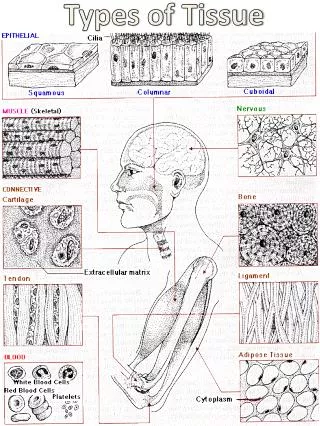
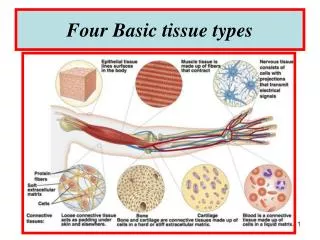
Muscle Tissue • Muscle tissue is a specialized tissue that are able to contract. • Two types of muscle tissue… • Voluntary-muscles that you are able to control • Involuntary-muscles that you cannot control
Skeletal Tissue • Skeletal tissue moves bones • Most common type of muscle • Voluntary muscles • Wear out quickly and tire more easily • Look branched or striated • Example: Tendons-the thick bands of tissue that attach muscle to bone.
Cardiac Muscle • Found only in the heart • Involuntary muscle • Contracts an average of 70 per minute each day • Cardiac muscle is striated, like skeletal muscle
Smooth (visceral) muscles-found in many internal organs • Involuntary muscles • Contract and relax slowly • Appear very branched, spindle-shaped • Examples: Blood vessels, bladder, stomach
Epithelial Tissue • Pack tightly together and form continuous sheets that serve as linings in different parts of the body. • A. lines our organs • B. ex. Stomach lining and outer layer of skin.
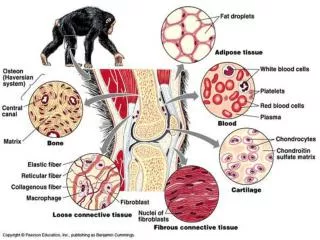
Connective tissue • There are many types of connective tissue in the body. • Adds support and structure to the body. • Some examples include inner layers of skin, tendons, ligaments, cartilage, bone and fat tissue. • Blood is also considered a form of connective tissue.
Nerve Tissue • Contains two types of cells: neurons and glial cells. • Has the ability to generate and conduct electrical signals in the body. • These electrical messages are managed by nerve tissue in the brain and transmitted down the spinal cord to the body. • Gives signals to muscles and informs us of environmental conditions (hot, cold, humid) • Examples are brain, spinal cord, nerves