The Enlightenment: The Age of Reason and Its Revolutionary Ideas
The Enlightenment, known as the Age of Reason, championed critical thinking and the reevaluation of social institutions and norms. Philosophers like Diderot, Voltaire, Montesquieu, Rousseau, Astell, Beccaria, Wollstonecraft, and Chatelet advocated for reason, nature, liberty, and progress. They questioned blind faith and promoted intellectual freedom. Key works such as Diderot's "Encyclopedia," Voltaire's "Candide," and Wollstonecraft's "A Vindication of the Rights of Women" laid the foundation for modern thought, emphasizing human rights and social justice.


The Enlightenment: The Age of Reason and Its Revolutionary Ideas
E N D
Presentation Transcript
The enlightenment The Age of Reason
Main Ideas • Ideas of 17th century – human behavior and institutions • Critical Spirit • Reexamine assumptions and social institutions • Question blind faith • Promote intellectual freedom
PRINCIPLES • Reason • Nature • Liberty • Progress • idealism
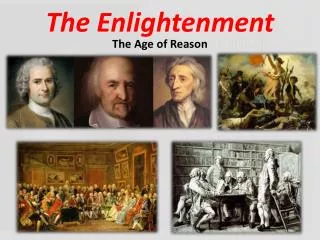
Diderot Voltaire Montesquieu Rousseau Astell Beccaria Wollstonecraft Chatelet Philosophes
Diderot • Encyclopedia • Classified Dictionary of the Sciences, Arts & Trades • Inventory of knowledge
Voltaire • Letters on England • Candide • Treatise on Toleration • “I do not agree with a word you say, but I will defend to the death your right to say it.”
Montesquieu • Spirit of the Laws • Basic need for the separation and balance of powers
Rousseau • The Social Contract • Emile • Popular Sovereignty • “Man is born free and everywhere he is in chains”
Astell • A Serious Proposal to the Ladies • “If all men are born free, how is it that all women are born slaves?”
Beccaria • On Crimes and Punishment • Achieve the greatest good for the greatest # of people
Wollstonecraft • A Vindication of the Rights of Women • Better education = equality and freedom
Chatelet • Translates the ideas of Newton into French • Institutions de Physique