Understanding Power in Electrical Circuits: Key Theorems and Concepts
This educational session covers critical concepts in electrical power analysis, including the principles of energy delivery and absorption, as outlined in Parseval’s theorem. Participants will learn how to analyze complex voltage waveforms by calculating their RMS (Root Mean Square) values, which serve as effective measures for power computation. We will also discuss integrity standards, grading policies, and provide a syllabus outlining office hours and homework expectations. Join us to enhance your understanding of electrical engineering fundamentals.

Understanding Power in Electrical Circuits: Key Theorems and Concepts
E N D
Presentation Transcript
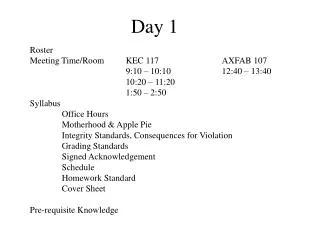
Roster Meeting Time/Room KEC 117 AXFAB 107 9:10 – 10:10 12:40 – 13:40 10:20 – 11:20 1:50 – 2:50 Syllabus Office Hours Motherhood & Apple Pie Integrity Standards, Consequences for Violation Grading Standards Signed Acknowledgement Schedule Homework Standard Cover Sheet Pre-requisite Knowledge Day 1
+ i(t) v(t) - Review Summary Subject to Passive Sign Convention: Positive power is power absorbed, Negative power is power provided. Energy Delivered/Absorbed in a time interval T:
A currrent (voltage) waveform of any complexity can be represented by a single number, its RMS or “effective value” for purposes of power computation. Define: Then:
Parseval’s Theorem If vc(t) = va(t) + vb(t) then Vc(rms)2 = Va(rms)2 + Vb(rms)2 Provided va(t) and vb(t) are “orthogonal” over the time interval of interest : . . .