
Atomic Structure
E N D
Presentation Transcript
Atomic Structure Chapter 4
Section 4.1 – Defining the Atom Introduction • The lab technician shown here is using a magnifying lens to examine a bacterial culture in a petri dish. • When scientists cannot see the details of what they study, they try to obtain experimental data that help fill in the picture.
1. Early Models of the Atom • An atom is the smallest particle of an element that retains its identity in a chemical reaction. • All matter is composed of atoms. • Democritus’s Atomic Philosophy • The name atom is based on the Greek word “atomos”, which means indivisible. • Democritus believed: • That atoms were indivisible and indestructible. • That the atoms differed in size and shape • Were in constant motion in a void, • Collided with each other; and during these collisions, could rebound or stick together. • Therefore, changes in matter were a result of dissociations or combinations of the atoms as they moved throughout the void Democritus
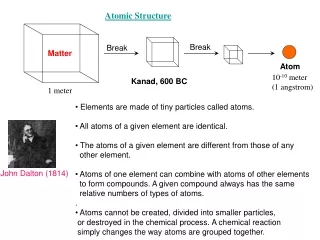
Early Models of the Atom (cont.) • Democritus’s ideas were limited because they didn’t explain chemical behavior and they lacked experimental support. • Aristotle said empty space did not exist & rejected Democritus • He said matter was composed of the elements EARTH, WATER, AIR, & FIRE • Dalton’s Atomic Theory • The modern process of discovery regarding atoms began with John Dalton, an English chemist and school teacher (1766-1844). • By using experimental methods, Dalton transformed Democritus’s ideas on atoms into a scientific theory.
Early Models of the Atom (cont.) • The result was Dalton’s Atomic theory. • All elements are composed of tiny indivisible particles called atoms. • Atoms of the same element are identical. • The atoms of any one element are different from those of any other element. • Atoms of different elements can physically mix together or can chemically combine in simple whole-number ratios to form compounds. • Chemical reactions occur when atoms are separated, joined, or rearranged. • Atoms of one element are never changed into atoms of another element in a chemical reaction. • His model of the atom was called the “billiard ball” model.