Efficient Evaluation of Arithmetic Expressions Using Expression Trees
This paper delves into advanced techniques for evaluating arithmetic expressions via expression trees. It discusses the bottom-up evaluation method and the application of tree contraction to optimize performance, achieving O(n) time complexity even for elongated trees. By associating labels to internal nodes and utilizing partial evaluations, we maintain the values through a proposed invariant. The text also introduces the rake operation, enhances the correctness of evaluations, and demonstrates how expression trees can lead to efficient computations in O(log n) time.

Efficient Evaluation of Arithmetic Expressions Using Expression Trees
E N D
Presentation Transcript
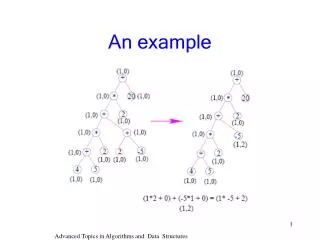
An example Advanced Topics in Algorithms and Data Structures
An example Advanced Topics in Algorithms and Data Structures
Evaluation of arithmetic expressions • If we evaluate an expression tree bottom-up, it will take O(n) time for a long and skinny tree. • Hence we apply tree contraction. Advanced Topics in Algorithms and Data Structures
Evaluation of arithmetic expressions • We do not completely evaluate each internal node. We evaluate the internal nodes partially. • For each internal node v, we associate a label (av, bv). av and bv are constants. • The value of the expression at node is: (av X + bv), where X is an unknown value for the expression of the subtree rooted at v. Advanced Topics in Algorithms and Data Structures
Keeping an invariant Invariant: • Let u be an internal node which holds the operation , . • Let v and w are the children of u with labels (av, bv) and (aw, bw). • Then the value at u is: val(u) = (avval(v) + bv) (awval(w) + bw) Advanced Topics in Algorithms and Data Structures
Keeping an invariant Advanced Topics in Algorithms and Data Structures
Applying the rake operation • The value at node u is: val(u) = (avcv + bv) (aw X + bw) • X is the unknown value at node w. Advanced Topics in Algorithms and Data Structures
Applying the rake operation • The contribution of val(u) to the value of node p(u) is: au val(u) + bu = au[(avcv + bv) (aw X + bw)] + bu • We can adjust the labels of node w to (a’w ,b’w) • a’w = au(avcv + bv) aw • b’w = au(avcv + bv) bw + bu Advanced Topics in Algorithms and Data Structures
Complexity of expression evaluation • The correctness of the expression evaluation depends on correctly maintaining the invariants. • We start with a label (1, 0) for each leaf and correctly maintain the invariant at each rake operation. • We have already proved the correctness of the rake operation. • Hence, evaluation of an expression given as a binary tree takes O(n) work and O(log n) time. Advanced Topics in Algorithms and Data Structures
An example Advanced Topics in Algorithms and Data Structures
An example Advanced Topics in Algorithms and Data Structures
An example Advanced Topics in Algorithms and Data Structures