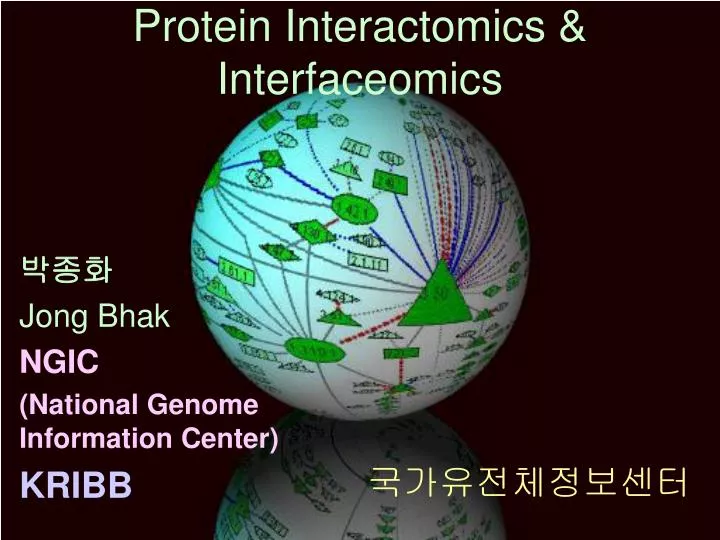

Protein Interactomics & Interfaceomics
E N D
Presentation Transcript
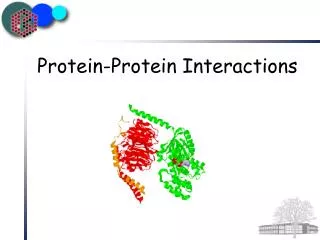
Protein Interactomics & Interfaceomics 박종화 Jong Bhak NGIC (National Genome Information Center) KRIBB 국가유전체정보센터
Acknowledgement • People who do science because science is interesting and fun. • People who support science and technology by paying tax. • MOST of Korea which funds NGIC. • KRIBB for funding and support.
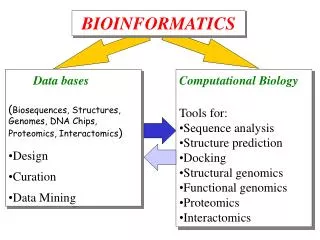
Content • Bioinformatics • Protein Informatics • Protein Interactomics & Interfaceomics
Brief History of Bioinformatics • Darwin: A theoretical biologist • Mendel: A theoretical prediction and validation • Perutz and Kendrew: structural biologists • Crick and Watson: DNA modellers • Crick, Brenner, : Codon • Sanger: DNA sequencing: Genomics • Sanger: Protein sequencing • Sanger: Proteomics • Lesk: Visualization of proteins • Needleman & Wunch: Computer algorithms • Southern: Hybridization Functional Genomics • Tim Berners-Lee 1990: HTTPD Internet
DNA codon anticodon peptide개념정리 • Bioinformatics Expanded • ·Structural genomics • Comparative genomics • ·Sequencing • ·Functional genomics • ·SNP • ·Proteomics (Mass spec. protein chip) • ·DataBases • ·Computational analysis Methodology Darwin (evolution) Mendel (genetic analysis) DNA modelling (Watson & Crick, 1953) Hemoglobin과Myoglobin의structure비교 (Max Perutz,John Kentreu) : structure 와sequence 양대영역 개념정리 structure sequence Bio-Computation Methodology (Chris Sander, Arther Lesk, etc ) X-174 genome (F.sanger) :full genome sequencing Dynamic program을 이용한 Sequence comparison app module (Niedleman & Bunsche) DB construction (Gen Bank, PIR, ...) DNA chip & Microarray technology Southern blot Hybridization methology Functions Computer INTERNET
Bioinformatics People ? • Explorers of 1300-1400 • Charting the unknown territory of Biological Life.
Long Definition of Bioinformatics • Bioinformatics is a discipline of science that analyses, seeks understanding and models the whole life as an information processing phoenomenon utilizingenergy with methods from philosophy, mathematics and computer science using biological experimental data. -- Jong Bhak
A short definition of Bioinformatics • Biology is bioinformatics and bioinformatics is biology. -- Jong Bhak
Research Domains of Bioinformatics • Sequence • Structure • Expression • Interaction • Function • Literature
What is Protein? • The most informative object in the biological universe. • Protein level is efficient to work with. a Naturally distinct unit. So, favoured by bioinformatic computing.
BioComplexity Density Chart Total complexity Size Scale Complexity degree Relative complexity 10-e10 10-e9 10-e6 10-e3 1 10
Why Interactome and Interactomics? • Context in Biology is always the problem of ‘interactions’ Dan Bolser & Jong Bhak, Genome informatics
Why Protein Intearctome ? • Protein Intearctome can give us the most valuable insights and information about biological functions in cells. (it is the best map you can have in biology) http://interactome.org
Why Structural Interactomics ? • Most definite. • Most informative • Most accurate • Directly connected to drug discovery. • Structural certain well-known forces and physical rules are considered. • Most fun and beautiful to work with ?
Funnel of Biological Drug Discovery Genomics Proteomics Interactomics Physiomics Structure Drug Discovery
The unit of Interaction Protein StructuralDomains
Protein A Protein B Interaction among domains
Hydrophobic core (interior) Protein surface Interface scaffold Water Molecule Interaction crust (+) Water Molecule geometric interface Interaction crust (-) Protein surface Interface scaffold Hydrophobic core (Interior)
What can we do with Interactomes? • The main academic goal of Interactomics • Mapping all the molecular interactions in cells
Computational Human Interactome • Mapping all the protein-protein and protein-ligand interactions using computational and experimental methods.
Structure DB Practical Steps of Complete Human Interactome Predicted Human Interactome
Comparative Interactomics • A large scale analysis of comparing interactomes of species to understand the evolution and function of cells.
Global view of protein family interaction networks for 146 genomes
Comparative Interactomics • We found that all 146 interactomes are scale-free networks, and they share a core protein-interactome comprising 36 protein families related to indispensable functions in a cell. • Daeui Park, Semin Lee, Dan Bolser, Michael Schroeder, Michael Lappe, Donghoon Oh, & Jong Bhak. Bioinformatics, 2005.
Eukarya and Prokarya • We found two fundamental differences among prokaryotic and eukaryotic interactomes: • 1) eukarya had significantly more hub families than archaea and bacteria, and • 2) certain special hub families determined the shapes of the eukaryotic interactomes.
Interfaceomics • http://interpare.net/ • Analyzing the actual interaction interfaces of protein-protein interactions. • Interfaceome: the whole set of interacting molecular pairs in cells. Wankyu Kim, Dan M. Bolser and Jong Park, Bioinformatics, 2004, 20(7):1138-1150.
InterFacer Choi HanSol
InterFacer • http://www.interfacer.org/
Goal of Interactomics & Interfaceomics • Fastest Drug Discovery Possible
References Large scale co-evolution analysis of Protein Structural Interlogues using the global Protein Structural Interactome Map(PSIMAP). Wankyu Kim, Dan M. Bolser and Jong Park, Bioinformatics, 2004, 20(7):1138-1150. Visualisation and Graph-theoretic Analysis of a Large-scale Protein Structural Interactome Dan M Bolser , Panos Dafas, Richard Harrington , Jong H Park and Michael Schroeder BMC Bioinformatics20034:45 Conservation of protein interaction network in evolution. Park J, Bolser D.Genome Informatics. 2001 ;12:135-40. Mapping protein family interactions: intramolecular and intermolecular protein family interaction repertoires in the PDB and yeast.Park J, Lappe M, Teichmann SA. J Mol Biol. 2001 Mar 30;307(3):929-38.
Brief Introduction on NGIC • 國家有傳體情保 (National Genome Information Centerhttp://ngic.re.kr/ ) NGIC was established with the vision to become the hub of Korean bioinformatics effort: 1) collects and distributes genomic and proteomic data, 2) provides bioinformaatic databases and analysis platforms 3) promotes domestic and international research collaborations in bioinformatics. Since 2001