Download
1 / 9
100 likes | 200 Views
Explore the diverse world of primates, from the primitive Prosimians to the more evolved Apes. Discover their unique features, behaviors, and habitats, from the nocturnal lemurs of Madagascar to the tool-using Capuchins. Compare New World and Old World monkeys, and delve into the fascinating evolution of the Great Apes in Africa and Asia. Learn about their locomotion, diet, social structures, and more in this comprehensive guide to primates.

E N D
Prosimians (before apes) • More primitive features as compared to monkeys • Many are nocturnal • Some have claws • Locomotion is vertical clinging and leaping (VCL)
Two types • Tarisiers, Lorises,Galagos, Aye-Aye, Pato, etc. • Found in Asia and Africa • Most primitive of the primates • Nocturnal
Lemurs • Madagascar • About 50 species • Only diurnal prosimians (isolated from mainland and competition from monkeys
Monkeys • Hominoids • Two kinds • New World (the Americas) • Old World (Africa, Europe & Asia) • New World • Diverse (evolved without competition with prosimians or apes: more niches to move into) • Lack a TRUE opposable thumb • Have a prehensile tail (Figure 7-10)
New World: Marmosets and Tamarins • Polyandry • Families with allomothering • Small • Many eat gum (tree sap)
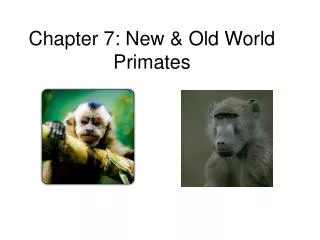
New World Monkeys • Owl/Night Monkey only nocturnal monkey • Eat leaves, fruits, & insects • Capuchins are tool users
Old World Monkeys • Langur (Asia), Colobus, Vervit, Baboons (Mandrils) • Quadrupeds • True Opposable Thumbs • Tails are not Prehensile
Apes • Ape radiation in Africa and Asia about 15 million years ago during the Miocene • About 10 – 14 mya most had become extinct • Monkey species expand at this time • Monkey ape niche competition? • Some monkeys move into non-rainforest habitats, Apes didn’t • Apes are larger bodied than other primates • Two kinds • Lesser Apes (Siamangs and Gibbons in Asia) • Great Apes (Chimps, Bonobos, Gorillas in Africa; and Orangutans in Asia; humans everywhere except Antarctica)