Understanding Groundwater: Sources, Movement, and the Water Table
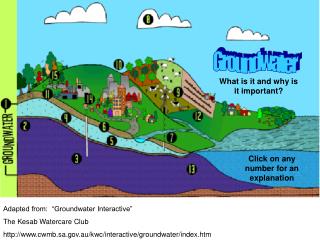
Groundwater is a critical component of Earth's hydrosphere, making up 10% of the world's freshwater, with the majority trapped in polar ice caps and glaciers. The depth and movement of groundwater depend on local conditions, topography, and the permeability of geological materials. The zone of saturation is where groundwater fills all pore spaces in soil and rock. Water movement is influenced by gravitational and capillary forces, primarily within aquifers, while aquicludes present barriers to flow. Explore the significance and dynamics of groundwater in this concise overview.

Understanding Groundwater: Sources, Movement, and the Water Table
E N D
Presentation Transcript
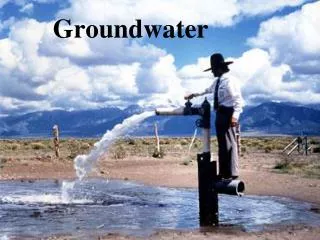
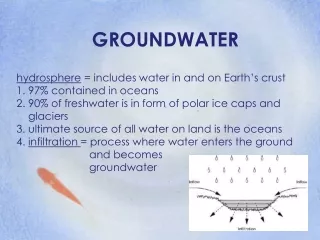
Where’s the Water? • Water can be reached from anywhere on Earth if a deep enough well is drilled • All water on and in Earth’s crust makes up the hydrosphere • 97% of all Earth’s water is in the oceans • 3% of all Earth’s water is considered freshwater • 90% of all freshwater is in polar ice caps and glaciers • 10% that remains is groundwater • <0.5% is easily accessible (lakes, streams, etc)
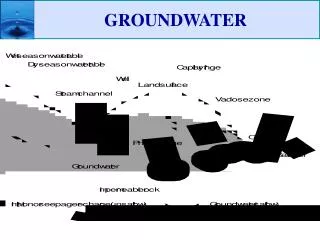
Zone of Saturation • Depth at which groundwater completely fills all the pores of a material • Gravitational – trickles downward due to the force of gravity • Capillary – drawn upward from the water table and held in pore spaces due to surface tension • The upper boundary of this zone is the water table
Location Matters • Water table follows the topography of the land above it • Water table depth depends upon local conditions • Stream valleys • Few meters deep • Swampy areas • At Earth’s surface • Hilltops, arid regions • Tens to hundreds of meters deep
Groundwater Movement • Rate of movement depends on two factors • Permeability of material (most important) • Slope of the water table • Most groundwater flows through permeable layers called aquifers • Aquicludes are impermeable layers • Clay (most impermeable), silt, shale