Download
1 / 13
130 likes | 236 Views
This quiz explores significant historical events and reforms of the 19th century, including the Compromise of 1867, which established Austria-Hungary's dual monarchy. It discusses Tsar Alexander II's reforms in Russia, notably the abolition of serfdom, the establishment of Zemstvos, and his assassination in 1881. It also covers notable British leaders during Queen Victoria's reign from 1837 to 1901, including William Gladstone and Benjamin Disraeli, and key social and political reforms of the period. Test your knowledge of these pivotal moments in history!

E N D
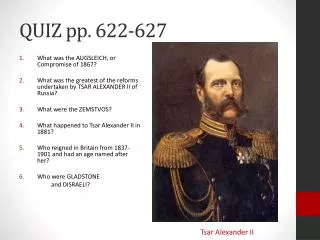
QUIZ pp. 622-627 • What was the AUGSLEICH, or Compromise of 1867? • What was the greatest of the reforms undertaken by TSAR ALEXANDER II of Russia? • What were the ZEMSTVOS? • What happened to Tsar Alexander II in 1881? • Who reigned in Britain from 1837-1901 and had an age named after her? • Who were GLADSTONE and DISRAELI? Tsar Alexander II
QUIZ ANSWERS • DUAL MONARCHY OF AUSTRIA-HUNGARY • ABOLITION OF SERFDOM/EMANCIPATION OF THE SERFS • LOCAL ELECTED COUNCILS • ASSASSINATED • QUEEN VICTORIA • LEADERS OF THE WHIGS AND TORIES
THE AUSTRIAN EMPIRE TOWARD A DUAL MONARCHY • The Von Bach plan 1851 unified system of admin, law, taxation Hungary placed under military rule • Economic troubles + the Italian War + the Austro-Prussian War = big trouble for Austria weakness • Hungary wants independence
THE AUGSLEICH = THE COMPROMISE OF 1867 • Creates the dual monarchy of Austria-Hungary • Each part has separate constit, legis, capital • Both states have the same ruler = Emperor Francis Joseph • States share foreign policy, army, finances
IMPERIAL RUSSIA • Russian defeat in the Crimean War = • Russia is falling behind W. Europe • Russia needs to reform and modernize
TSAR ALEXANDER II (1855-1881) • The great reforming tsar • Comes to power in the middle of the Crimean War • Attempts to overhaul the Russian system • Abolition of serfdom 1861 • Zemstvos = elected local assemblies • Legal reforms – regular system of local and provincial courts
REFORMERS vs. CONSERVATIVES IN RUSSIA = WESTERNIZERS vs. SLAVOPHILES • Reformers – • Wanted more and faster change • ALEXANDER HERZEN = peasant must be chief instrument of reform = Populism a. a type of socialism b. village peasant commune is a type of natural organic socialism c. peasant commune should be basis for a new Russian society d. failed • Some reformers turned to more radical and violent ideas = THE PEOPLE’S WILL = terrorism a. revolutionary group b. assassinate Tsar Alexander II in 1881
TSAR ALEXANDER III (1881-1894) • Comes to power when his father is assassinated • Turns against reform • Rules in an autocratic repressive way = reactionary Tsar Alexander III
WHY NO REVOLUTION OF 1848 IN BRITAIN? • THE REFORM ACT OF 1832 = first move to expand the franchise = expand voting rights • Effective parliament = responds to the people • Social and political reforms • Economic growth
GREAT BRITAIN – THE VICTORIAN AGE • mid-century Britain • Named after Queen Victoria (1837-1901) • Period of strict morality, duty, family values, prim and proper • Lord Palmerston = PM 1855-1865 = not reformer = no new voting rights • After 1865 political changes = new voting rights Queen Victoria
KEY POLITICAL FIGURES OF VICTORIAN ENGLAND WILLIAM GLADSTONE = leader of the liberals BENJAMIN DISRAELI = leader of the conservatives
Major reforms in the Victorian Era • THE REFORM ACT OF 1867 = extends voting rights to male urban workers • Competitive exams for civil service jobs/not patronage or connections • Secret ballot for voting • Abolishes purchasing of military commissions • THE EDUCATION ACT OF 1870 = elementary education for all children