Download
1 / 12
120 likes | 222 Views
DNA is a double helix composed of complementary, antiparallel strands. Its backbone consists of a five-carbon sugar and phosphate group, with bases forming the rungs. Two classes of nitrogenous bases—purines (adenine and guanine) and pyrimidines (thymine and cytosine)—define its structure, while RNA has uracil instead of thymine. DNA replication is semiconservative and requires various enzymes including helicases, polymerases, and primase. This process is critical for maintaining genetic integrity, with distinct structures such as A-DNA, B-DNA, and Z-DNA occurring under different conditions.

E N D
Nucleic Acids Jon Wilson Cell Physiology
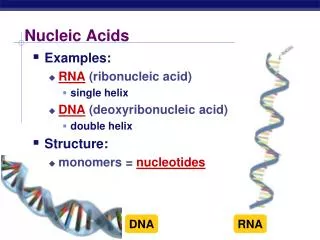
Structure of DNA • DNA is a double helix made of complimentary antiparallel strands • The backbone is constructed of a five carbon sugar and a phosphate group • The rungs consist of the different bases
Structure of Nucleic Acids • DNA is a five carbon sugar with two hydrogen’s on the second carbon • RNA is a five carbon sugar with a hydrogen and hydroxyl group on the second carbon
Structure of the DNA bases • Two classes of bases: Purines and Pyrimidines • Purines consist of Adenine (A) and Guanine (G) • Pyrimidines consist of Thymine (T) and Cytosine (C) • Bases are the same in RNA except that Uracil (U) is substituted for Thymine
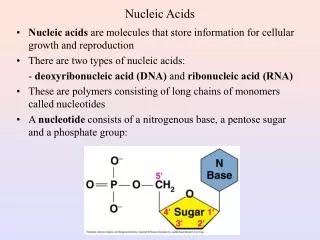
Backbone linkage • Any nucleotide can be connected with a phosphodiester bond • Nucleotides are triphosphated • The 5’ ends with a phosphate and the 3’ ends with a hydroxyl • The phosphate is attached to the 5’ carbon and the 3’ carbon of the sugar • The bases are attached to the first carbon
DNA Linkage • Helix is anti-parallel and complimentary • Left side is from 5’ end to 3’ end • Right side is from 3’ end to 5’ end • A matches with T Stabilized by two hydrogen bonds • C matches with G Stabilized by three hydrogen bonds
DNA Replication • Replication is semi-conservative • Each strand is a template for another strand • New DNA strands contain one new strand and one parental strand • Bases on strands are complimentary (A w/ T & C w/ G)
DNA Replication • DNA synthesizes in one direction, from the 5’ end to the 3’ OH end • Many enzymes contribute in the replication of DNA Helicases- unwind the DNA Topoisomerases- releases the tension Single Stranded Binding Proteins- maintain the single strands after unwinding DNA polymerases- add nucleotides and reads the template strand. There are five polymerases for mammals. Must have a 3’ OH end
DNA Replication • DNA polymerase cannot initiate the synthesis of new DNA, it can only extend a chain • RNA polymerase do not require a 3’ OH end • A RNA polymerase called primase synthesis a piece of RNA on the DNA template • This hybrid of RNA-DNA is called the primer • The primer produces the 3’ OH end needed for DNA polymerase
Types of DNA Structures • B DNA The usual form of DNA A right handed helix Has a helical turn every 10 base pairs Has a Major groove and a Minor groove • Z DNA Has a zig-zag appearance Has more bases per turn than B DNA Caused by a high salt concentration and certain proteins
Types of DNA Structures • A DNA Has 11 base pairs per turn Contains a central hole Adopted by RNA-DNA & RNA-RNA helices • Triple-Helix DNA Also called H DNA Can occur in stretches where all purines in one strand are paired up with all pyrimidines in the other strand
Summary • DNA is a double helix with complementary anti-parallel strands • DNA consists of sugar, phosphate and bases • There are two classes of bases: Purines and Pyrimidines • Nucleotides are connected by a phosphodiester bond • Replication is semi-conservative from the 5’ end to the 3’ end and involves many enzymes • There are four known types of DNA structures: A DNA, B DNA, H DNA and Z DNA