SUPPLY AND DEMAND
This guide explores the fundamental concepts of supply and demand, including their laws, schedules, and the relationship between price and quantity. It explains key terms like marginal utility, income effect, and substitution effect, as well as how these factors influence buying decisions. The guide also covers how to create and interpret demand and supply graphs, shifts in curves, and the equilibrium point where supply meets demand. Additionally, it discusses surplus and shortage scenarios and their effect on market prices, providing a comprehensive overview of market dynamics.


SUPPLY AND DEMAND
E N D
Presentation Transcript
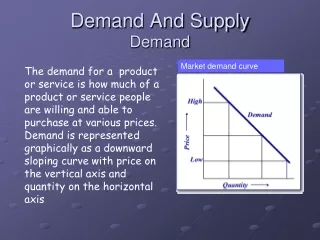
Demand • Demand – the willingness and ability of people to buy a product at a certain price • Law of Demand – people buy more of a product at a lower price • As price goes up, willingness to buy goes down • Demand and price have an INVERSE relationship PRICE DEMAND
Proving the Law of Demand • Diminishing marginal utility • Income Effect • Substitution Effect
Diminishing Marginal Utility • What is marginal utility? • The satisfaction one gets from one more unit of a product • With every additional unit consumed in a certain time period, additional satisfaction decreases More units Satisfaction
Income Effect The effect that increasing or decreasing prices have on income. • As price goes up, your buying power goes down • As price goes down, buying power increases
Substitution Effect The change in the mix of goods purchased as a result of increasing and decreasing relative prices. • Price of OJ goes up, consumers substitute with apple juice • Price of beef falls, consumers substitute beef for chicken or pork
Demand Schedule • Shows how much (QUANTITY) of a product people will buy at a certain price
Graphing Demand Use the demand schedule to create a demand graph Demand for Bikes • Always title graph • Always label axis • X axis = always quantity • Y axis = always price • Accurate scale • Plot points & connect • Label curve 350 Demand curve is always NEGATIVE 300 PRICE 250 200 150 D 100 5 10 15 20 25 30 35 40 QUANTITY
Determinants of Demand What causes demand to change? • Consumer Incomes • Consumer Attitudes • Complementary Goods • products that are used together – gas & cars • Substitute Goods • Goods that can take the place of other goods – Butter & Margarine ; name brand & generic
Shifting Demand on a graph • Increase in demand = line shifts up to the right • Decrease in demand = line shifts down to the left 350 300 PRICE 250 D1 200 150 D 100 D2 5 10 15 20 25 30 35 40 QUANTITY
SUPPLY • Supply – the quantity of products that a firm is willing & able to make available for sale at different prices • Law of Supply – the quantity of goods supplied will be greater at a higher price than at a lower price • As price goes up, production goes up • Price & supply have a DIRECT relationship PRICE SUPPLY
Supply Schedule • Shows the quantity of a product producers are willing to supply at different prices • Using your demand schedule, invert your numbers for quantity, keeping price the same • Using an X/Y graph, plot this new schedule; Be sure to title, label axis, and provide accurate scale
Graphing Supply Supply of Bikes 350 S 300 PRICE 250 200 Supply curve is always POSITIVE 150 100 5 10 15 20 25 30 35 40 QUANTITY
Shifting Supply • Increase in supply = line shifts down to the right • Decrease in supply = line shifts up to the left S2 350 300 PRICE S 250 S1 200 150 100 5 10 15 20 25 30 35 40 QUANTITY
Finding Equilibrium • Equilibrium occurs where Supply & Demand intersect • When S=D, you found E • Equilibrium also known as market clearing price • What is the market clearing price in this example? 350 S 300 PRICE 250 E 200 150 D 100 5 10 15 20 25 30 35 40 QUANTITY
Shortagesquantity demanded > quantity supplied = Shortage • Results when a seller charges less than the equilibrium price • All points below E would result in a shortage • Upward pressure on price • When there are shortages, prices go up S PRICE E Price D QUANTITY
SURPLUSquantity demanded < quantity supplied = surplus Price • Results when a seller charges more than the equilibrium price • All points above E would result in a surplus • Downward pressure on price • When there are surpluses, prices go down S PRICE E D QUANTITY