Understanding Earth's Evolution: Water, Life, and the Moon's Origins
This chapter explores the intricate structure and evolution of Earth, focusing on the vital role water and life play in shaping our planet. It delves into theories surrounding the origin of water and air, the emergence of life, and the potential for abiotic generation of amino acids in space. Additionally, the chapter provides a comparative analysis of the Earth and its solitary moon, covering their dimensions, mass, and hypotheses regarding the Moon's origin. Join us in discovering the interconnectedness of Earth's elements and celestial relationships.

Understanding Earth's Evolution: Water, Life, and the Moon's Origins
E N D
Presentation Transcript
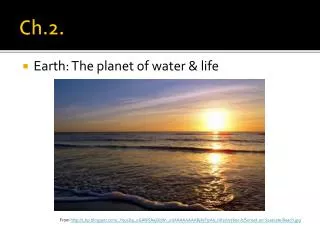
Ch.2. • Earth: The planet of water & life From http://1.bp.blogspot.com/_Y9ucDp_oGA8/SAejGbW-_eI/AAAAAAAABjA/F3rAo_hX1vI/s1600-h/Sunset-on-Seascale-Beach.jpg
The Earth’s structure From http://www.uwsp.edu/geo/faculty/ritter/glossary/a_d/asthenosphere.html
The Earth’s evolution • Origin: homogeneous vs. sequentially aggregated Earth • Origin of water and air : from self evolution vs. grabbing planetesimal/cometesimal • Appearance of life: abiotic spontaneous generation? Cosmogenic? • Oxygen • Present Earth
From http://geodynamics.rice.edu/tobias.hoeink/index.php?page=research
The origin of life? Figure: Amino acids, the 'building blocks' of life, may form in dust grains in the space between the stars. (c) ESA 2002. From http://www.astrobiologia.pl/eana/originoflife.html
From http://www.astro.wisc.edu/~townsend/static.php?ref=diploma-9
Ch.2. • Moon: The only satellite of the Earth From http://sos.noaa.gov/datasets/solar_system/moon.html
The comparison of Moon with Earth • EarthMoon • Mean diameter 12,742 km 3,476 km • Volume 1.08321 x 10¹² km32.199 x 1010 km3 • Mass 5.9736 x 1024 kg 7.349 x 10²² kg • Mean density 5.515 3.342 • Surface gravity 9.78 m/s2 1.62 m/s2 • Escape velocity 11.2 km/s 2.38 km/s • Visual albedo 0.367 0.12 • Visual magnitude -3.86 +0.21
The hypotheses of the origin of the Moon • Fission • Capture • Co-accretion • Gigantic impact From http://www.astronomynotes.com/solarsys/s13.htm