Download
1 / 3
30 likes | 140 Views
The IRAM architecture combines low power usage with high performance, tailored for multimedia applications. It integrates mixed logic and DRAM, optimizing on-chip bandwidth while achieving 3.2 Gflops at only 2 watts. With a focus on parallelism, vector processing, and simple issue control logic, it shifts complexity to the compiler, facilitating scalability across generations. ISTORE emphasizes the critical need for robust storage and retrieval, with future designs targeting thousands of nodes, enhancing reliability, availability, and maintainability through innovative monitoring and introspection techniques.

E N D
IRAM and ISTORE David Patterson, Katherine Yelick, John Kubiatowicz U.C. Berkeley, EECS http://iram.cs.berkeley.edu/{istore}
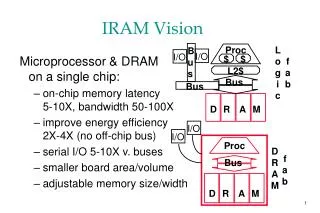
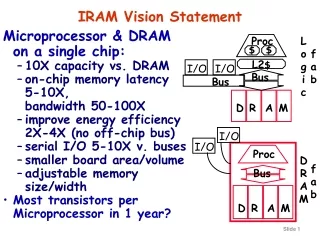
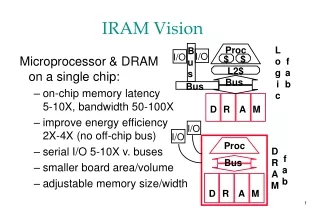
IRAM Overview • Low power, high performance processor for multimedia • Mixed logic and DRAM • On-chip bandwidth, low power • Vector processing • Parallelism replace high clock • 200 MHz, 3.2 Gflops, 2 Watts • Simple issue and control logic (power, area) • Push complexity into compiler; well-understood model • Compare to SIMD media extensions (MMX, VIS,…) • Multimedia has fine-grained data parallelism. • Scalable, multi-generation instruction set • Working with application experts (video and speech)
ISTORE Overview • Two kill applications for future • Storage and retrieval • Design points • 2000: 80 nodes in 3 racks • 2001: 1000 nodes with IBM (?) • 2005: 10K nodes in 1 rack (?) • Add IRAM to 1” disk • Key problems are availability, maintainability, and evolutionary growth (AME) of a thousand node servers • Approach • Hardware built for availability: monitor, diagnostics • New class of benchmarks for AME • Reliable systems from unreliable hw/sw components • Introspection: the system watches itself