Download
1 / 62
620 likes | 759 Views
This webcast, led by Sue Pearson, explores the essential principles and strategies of differentiated instruction. Participants are encouraged to reflect on their understanding of differentiated instruction, set personal goals, and engage with various techniques that address the unique needs of students. By fostering an enriched environment that values diverse learning pathways, educators will learn how to effectively maximize student growth, engagement, and achievement. Explore key focus areas such as flexible grouping, effective questioning, and promoting collaboration among students.

E N D
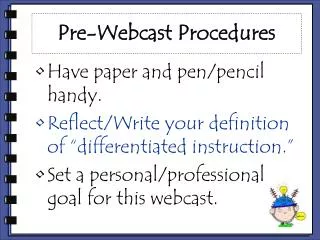
Pre-Webcast Procedures • Have paper and pen/pencil handy. • Reflect/Write your definition of “differentiated instruction.” • Set a personal/professional goal for this webcast.
HET: The Model for Differentiating Instruction Highly Effective Teaching: Sue Pearson
What is Differentiated Instruction? HET Differentiates Instruction Differentiating Instruction: Strategies HET: A Model for Differentiating Instruction
How would you define* differentiated instruction?
Differentiated instruction happens when you consistently and proactively create different pathways to help all your students be successful!
Why Differentiate? • Unique brain in each student’s head • Wide range of abilities in each class • Gender research • State mandates • Time crunch!
Goals of Differentiated Instruction • Build relationships w/students • Provide rigor and relevance for all • Maximize each student's growth • Offer different learning experiences in response to students' varied needs (Tomlinson, 2000).
Enriched Environment Absence of Threat/ Nurturing Reflecting Thinking Movement BODYBRAIN COMPATIBLE ELEMENTS SUPPORT DIFFERENTIATION Collaboration Mastery/ Application Meaningful Content Choices Immediate Feedback Adequate Time © H.E.T. 2007
Differentiating Instruction: 4 FOCUS AREAS • Engagement • Questioning • Flexible Grouping • Assessment ☺HET Differentiation processes/strategies
Differentiation throughENGAGEMENT • Brain information☺ • LG/LS☺ • Procedures☺ • Agenda☺ • Surveys: Temperament/personality, Interest, MI☺
Sample Inventory Questions • I am safe. • I have fun learning. • I like this school. • My teacher cares about me. • My teacher listens to my ideas. • My teacher believes I can learn • SAMPLE SURVEY: http://tinyurl.com/35ld5eb
8:00 A_____________ 9:00 A_____________ 10:00 A_____________ 11:00 A_____________ 12:00 P_____________ 1:00 P_____________ 2:00 P_____________ 3:00 P_____________ 4:00P______________ 5:00P______________ 6:00 P_____________ 7:00 P_____________ 8:00 P_____________ 9:00 P_____________ 10:00P ____________ 11:00P ____________ Daily Appointment Calendar forName_____________________
THAT’S ME! Finding commonalities is a brain-compatible way to make the brain feel safe. • Listen to my statement. • If that statement is true for you, stand and say “That’s me!” Variation: Teacher makes statements relating to topics of study. . . “I can name 3 states of matter.”
Yearlong Research Project☺ • Select a topic of personal interest (can be within or out of grade level curriculum) • Create something new with the information. • Present to class, parents, other classes • Teach research skills • Provide one hour weekly as group-other times when work is completed (3C’s) • Offer presentation projects using MI • Share at year-end celebration!
Time to Choose Which engagement strategies will you use to provide differentiation? • Clock/Appointment Partners☺ • That’s Me • Yearlong Research Project☺
Differentiation throughQUESTIONING • Teacher and Students • Safe to ask/post☺ • Closed/Open Questions • Use as assessment tool • Bloom’s Taxonomy☺ • Model higher level thinking questions-variety is key!☺
Evaluation: Why do you agree/disagree? Synthesis: How would you create a…? Analysis: How is this alike/ different from…? Application: How could you use…? Comprehension: Given ___ what would you predict___? Knowledge: Who, what, when, where is___? HOT Questions Bloom’s Taxonomy☺
Going Around in My Brain • Enlarge to poster size. • Laminate. • Students post their questions on Post-it notes to the chart. • Assess/Discuss
GIVE ME! • Meet with _____ appointment partner. • Students touch own hands as they share information about the story they just read. • Model with book. Give graphic organizer and ask students to fill in their own answers to the questions. • Give students hand organizer to complete. • *Note: Organizer may be filled out before or after meeting w/partner.
Give Me Five! What was this mostly about? What might happen next? What do I know now, even though I wasn’t given the info in the text? What does this remind me of? What mental picture do I see?
Time to Choose Which questioning strategies will you use to provide differentiation? • Hot Questions☺ • Parking Lot • Going Around in My Brain • Give Me Five
Differentiation through FLEXIBLE GROUPING • Planned/Random • Whole group • Partners/Triads/Quads☺ • Learning Club☺ • Small groups-varying degrees of readiness • Small groups-like readiness • Interest groups☺ • Independent☺
Groups-Accountability • Teach collaborative strategies • Set agreements • Mingle as groups are working • Daily reflection • Individual/group evaluation *Other considerations: try all boy/girl groups-brain research (Michael Gurian)
Group Roles☺ • Leader: facilitates; keeps group going • Timekeeper: monitors time • Materials Manager: Gets materials • Recorder: Summarizes group work in writing • Reporter: Summarizes group work orally • Scout: Seeks info from other groups • Encourager: Cheerleader for group
Brainstorming: A to Z☺ • For a singular topic; develops vocabulary. • Develop a list BEFORE reading; generate ideas, make connections to what they think will be in the content. • Review content: after completing a lesson/unit, invite students to work w/clock partner. Create list of words all words related to that topic.
Brainstorming A to Z Topic: Geometry
Put students into groups of 4. Count off 1, 2, 3, 4. Pose question/raise issue for discussion Put heads together; provide process time; make sure everyone knows the answer. When you call out a number, that person in each group will stand (try spinner). Call on one student for an answer or ask for a choral response. Numbered Heads Together☺ Multiple Content Areas and grade levels-Kagan; Cooperative Learning 1999
Time to Choose Which flexibility strategies will you use to provide differentiation? • Group Roles/Reflection☺ • A to Z: Brainstorming☺ • Numbered Heads Together☺ • 4-6-8
Differentiation through ONGOING ASSESSMENT • Guides and drives instruction • Assess before, during and after instruction • Provide numerous opportunities for students to demonstrate understanding in a variety of formats • Give timely feedback • Discuss correct and incorrect information
HET Inquiries☺ • Support both steps in two-step learning-pattern to program building. • Support the “key” points • Connect to prior experiences and skills • Offer differentiation & choice • Allow students to see, practice and apply concepts and skills in real-world context
Brain Basics: Assessment The brain: • Needs 29-50 times of doing something (pattern) before it becomes a program (repeatable at will) • Needs immediate feedback-e.g., homework, class work, tests • Wants to know what is being assessed • Should be assessed on what is valuable learning for life
Assess 1st thing in morning Reset their brains – acknowledge how they feel Australia-quiet area, executive timer, guest book, music (40-60- beats per minute) Would you like a Handshake, Hug, High Five Or How would you like to be greeted? GREETINGS the 4-H WAY☺
According to Howard Gardner… • An intelligence isn’t strong or weak; it is developed or less developed. • One can develop a less developed intelligence. • The Intelligences are used to solve problems and produce products. • They provide opportunities for us to give information out-not take it in!
Multiple Intelligences☺ http://surfaquarium.com/Mi/inventory.htm Kids: http://tinyurl.com/n6xopw
Mind Your Own Business • Invite students to design their own business cards (index card/real cards) • Post expertise in academic & non-academic areas. Identify LG/LS strengths. • Add clip art. • Hand out or post. *Note: Can make REAL business cards or facsimile
Line Up! Pre-assessment
Line Up! Pre-assessment
Signal Cards! • Use 3 index cards (5X8) per student. • Label one “YES”, one “MAYBE” and one “NO”. • When you ask a question, students hold up card that indicates whether or not they know the answer. • Call on students with “YES” cards to hold them accountable. YES MAYBE NO
Time to Choose Which assessment strategies will you use to provide differentiation? • MI Surveys☺ • Mind Your Own Business • Line up! • Signal Cards YES
CLOSURE! Reflect on: • Your original per./prof. goal • Strategies you chose • Final Quotation
To Quote Einstein . . . “I never teach my pupils. I only attempt to provide the conditions in which they can learn.”
Resources Betty Hollas Diane Heacox Free Spirit Publishing Vicki Gibson & Jan Hasbrouck
Next Webinar~June 17 HET: Citizenship Teaching and Using the Lifelong Guidelines and LIFESKILLS IN and OUTSIDE of the Classroom
Contact Me? • Sue Pearson • susanpiti@aol.com