
Echo server
E N D
Presentation Transcript
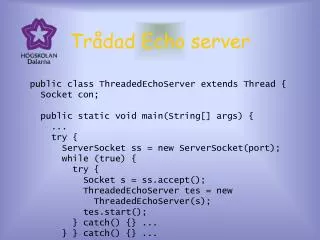
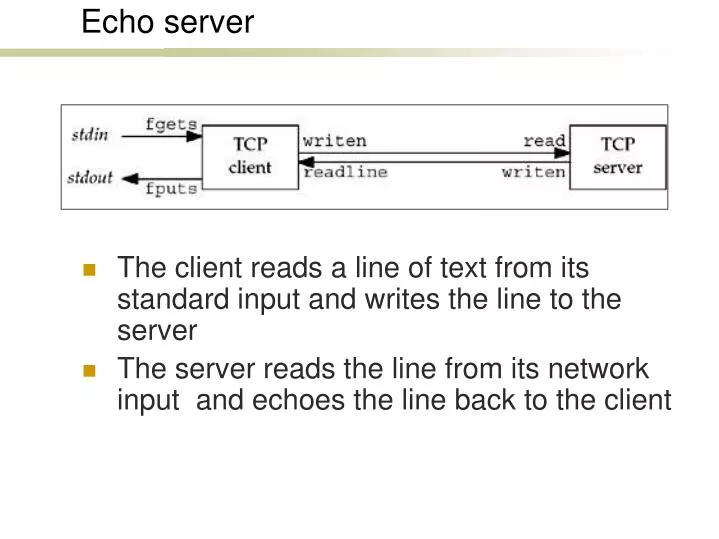
Echo server • The client reads a line of text from its standard input and writes the line to the server • The server reads the line from its network input and echoes the line back to the client
Echo server 1 #include "unp.h" 2 int 3 main(int argc, char **argv) 4 { 5 int listenfd, connfd; 6 pid_t childpid; 7 socklen_t clilen; 8 struct sockaddr_in cliaddr, servaddr; 9 listenfd = Socket (AF_INET, SOCK_STREAM, 0); 10 bzero(&servaddr, sizeof(servaddr)); 11 servaddr.sin_family = AF_INET; 12 servaddr.sin_addr.s_addr = htonl (INADDR_ANY); 13 servaddr.sin_port = htons (SERV_PORT); 14 Bind(listenfd, (SA *) &servaddr, sizeof(servaddr)); 15 Listen(listenfd, LISTENQ); 16 for ( ; ; ) { 17 clilen = sizeof(cliaddr); 18 connfd = Accept(listenfd, (SA *) &cliaddr, &clilen); 19 if ( (childpid = Fork()) == 0) { /* child process */ 20 Close(listenfd); /* close listening socket */ 21 str_echo(connfd); /* process the request */ 22 exit (0); 23 } 24 Close(connfd); /* parent closes connected socket */ 25 } 26 }
Echo server 1 #include "unp.h" 2 void 3 str_echo(int sockfd) 4 { 5 ssize_t n; 6 char buf[MAXLINE]; 7 again: 8 while ( (n = read(sockfd, buf, MAXLINE)) > 0) 9 Writen(sockfd, buf, n); 10 if (n < 0 && errno == EINTR) 11 goto again; 12 else if (n < 0) 13 err_sys("str_echo: read error"); 14 }
Echo client 1 #include "unp.h" 2 int 3 main(int argc, char **argv) 4 { 5 int sockfd; 6 struct sockaddr_in servaddr; 7 if (argc != 2) 8 err_quit("usage: tcpcli <IPaddress>"); 9 sockfd = Socket(AF_INET, SOCK_STREAM, 0); 10 bzero(&servaddr, sizeof(servaddr)); 11 servaddr.sin_family = AF_INET; 12 servaddr.sin_port = htons(SERV_PORT); 13 Inet_pton(AF_INET, argv[1], &servaddr.sin_addr); 14 Connect(sockfd, (SA *) &servaddr, sizeof(servaddr)); 15 str_cli(stdin, sockfd); /* do it all */ 16 exit(0); 17 }
Echo client 1 #include "unp.h" 2 void 3 str_cli(FILE *fp, int sockfd) 4 { 5 char sendline[MAXLINE], recvline[MAXLINE]; 6 while (Fgets(sendline, MAXLINE, fp) != NULL) { 7 Writen(sockfd, sendline, strlen (sendline)); 8 if (Readline(sockfd, recvline, MAXLINE) == 0) 9 rr_quit("str_cli: server terminated prematurely"); 10 Fputs(recvline, stdout); 11 } 12 }
Netstat • linux % tcpserv01 & [1] 17870 • linux % netstat -a Active Internet connections (servers and established) Proto Recv-Q Send-Q Local Address Foreign Address State tcp 0 0 *:9877 *:* LISTEN • linux % tcpcli01 127.0.0.1 • linux % netstat -a Active Internet connections (servers and established) Proto Recv-Q Send-Q Local Address Foreign Address State tcp 0 0 local host:9877 localhost:42758 ESTABLISHED tcp 0 0 local host:42758 localhost:9877 ESTABLISHED tcp 0 0 *:9877 *:* LISTEN • linux % ps -t pts/6 -o pid,ppid,tty,stat,args,wchan PID PPID TT STAT COMMAND WCHAN 22038 22036 pts/6 S -bash wait4 17870 22038 pts/6 S ./tcpserv01 wait_for_connect 19315 17870 pts/6 S ./tcpserv01 tcp_data_wait 19314 22038 pts/6 S ./tcpcli01 127.0 read_chan
Netstat (termination) • linux % netstat -a | grep 9877 tcp 0 0 *:9877 *:* LISTEN tcp 0 0 localhost:42758 localhost:9877 TIME_WAIT • linux % ps -t pts/6 -o pid,ppid,tty,stat,args,wchan PID PPID TT STAT COMMAND WCHAN 22038 22036 pts/6 S -bash read_chan 17870 22038 pts/6 S ./tcpserv01 wait_for_connect 19315 17870 pts/6 Z [tcpserv01 <defu do_exit
Normal termination • When EOF is typed fgets returns the Ao digitar EOF, fget returns a null pointer and str_cli returns • The client exits • Client’s descriptors are closed and a FYN segment is sent to the server • Server in state CLOSE_WAIT and client in state FIN_WAIT-2
Normal termination • The server child was blocked at the readline command (str_echo) and it returns to main. Server child ends by executing exit • All server child descriptors are closed A FIN segment is sent to the client • Connection ended • A SIGCHLD signal is sent
Signal • Software interrupt • Process to process or kernel to process • SIGACTION specifies disposition (or action). Three options: • Specify the handler: void handler (int signo) – a function that is called whenever a specific signal occurs • Ignore the signal by setting its disposition to SIG_IGN • Sets default SIG_DFL. The default is to terminate the process • SIGNAL – two arguments: name of the signal and either a pointer to a function or a constant SIG_IGN or SIG_DFL
Signal 1 #include "unp.h" 2 Sigfunc * 3 signal (int signo, Sigfunc *func) 4 { 5 struct sigaction act, oact; 6 act.sa_handler = func; 7 sigemptyset (&act.sa_mask); 8 act.sa_flags = 0; 9 if (signo == SIGALRM) { 10 #ifdef SA_INTERRUPT 11 act.sa_flags |= SA_INTERRUPT; /* SunOS 4.x */ 12 #endif 13 } else { 14 #ifdef SA_RESTART 15 act.sa_flags |= SA_RESTART; /* SVR4, 4.4BSD */ 16 #endif 17 } 18 if (sigaction (signo, &act, &oact) < 0) 19 return (SIG_ERR); 20 return (oact.sa_handler); 21 }
Signal • Once handler is installed, it remaisn installed • When handler is executed, the signal being delivered is blocked. Any additional signal that were specifeid in the mask as_mask signal set passed by sigaction when handler was installed are also blocked. • Signals are not queued – delivered once • Selectively blocking by using sigprocmask
Signal • Zombie state mantains information about child for the parent to fetch at later time. • Information includes process ID of the child, its termination status and on resource utilization • Zombieo occupies space and can run out of process space • Must wait child terminate to avoid them to become zombies • The handler mus be executed after a listen Signal (SIGCHLD, sig_chld)
Signal • Wait and waitpid returns the process ID and the termination status • Macros can be used to check this information • Wait blocks the calling process and waitpid has the option to block or not #include <sys/wait.h> pid_t wait (int *statloc); pid_t waitpid (pid_t pid, int *statloc, int options); Both return: process ID if OK, 0 or–1 on error
Signal • Cuncurrent wait – does not enqueue zombie processes
Signal • Waitpid → waits for temination of any children Option WNOHANGdoes not block 1 #include "unp.h" 2 void 3 sig_chld(int signo) 4 { 5 pid_t pid; 6 int stat; 7 while ( (pid = waitpid(-1, &stat, WNOHANG)) > 0) 8 printf("child %d terminated\n", pid); 9 return; 10 }
Signal 1 #include "unp.h" 2 int 3 main(int argc, char **argv) 4 { 5 int listenfd, connfd; 6 pid_t childpid; 7 socklen_t clilen; 8 struct sockaddr_in cliaddr, servaddr; 9 void sig_chld(int); 10 listenfd = Socket (AF_INET, SOCK_STREAM, 0); 11 bzero (&servaddr, sizeof(servaddr)); 12 servaddr.sin_family = AF_INET; 13 servaddr.sin_addr.s_addr = htonl(INADDR_ANY); 14 servaddr.sin_port = htons(SERV_PORT); 15 Bind(listenfd, (SA *) &servaddr, sizeof(servaddr)); 16 Listen(listenfd, LISTENQ); 17 Signal (SIGCHLD, sig_chld); /* must call waitpid() */ 18 for ( ; ; ) { 19 clilen = sizeof(cliaddr); 20 if ( (connfd = accept (listenfd, (SA *) &cliaddr, &clilen)) < 0) { 21 if (errno == EINTR) 22 continue; /* back to for() */ 23 else 24 err_sys("accept error"); 25 } 26 if ( (childpid = Fork()) == 0) { /* child process */ 27 Close(listenfd); /* close listening socket */ 28 str_echo(connfd); /* process the request */ 29 exit(0); 30 } 31 Close (connfd); /*parent closes connected socket*/ 32 } 33 }
Connection abortion • Connection abortion before returning accept solution is SO dependent
SIGPIPE • Process performs a write operation to a socket that received a RST • Defaultis to terminate the process
Server crash • After a default number of attempts, client receives either the error code EPTIMEDOUT or EHOSTUNREACH (in case a router sends na ICMP message) • Option SO_KEEPALIVE to verify if server is alive
Server crash • If server crashes and reboots before client send data, upon receiving data from client server send na RST • Client returns error code ECONRESET