Download

1 / 23
230 likes | 356 Views
This chapter defines psychological health and mental well-being, contrasting it with common misconceptions. It highlights Abraham Maslow’s Hierarchy of Needs and discusses the traits associated with self-actualization. The text also explores various psychiatric disorders, such as anxiety and mood disorders, and provides information on their symptoms, causes, and treatment options. Emphasis is placed on the neurological basis of these disorders and the importance of understanding human motivation for effective therapeutic change.

E N D
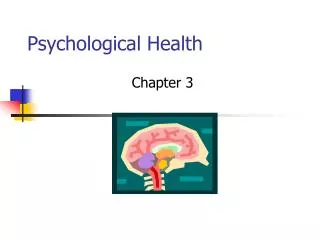
Psychological Health Chapter Three
Defining Psychological Health • Psychological Health (Mental Health) is a level of psychological well-being, or the absence of mental illness
Defining Psychological (Mental) Health • You are not psychologically healthy because: • you are normal (average) • you conform to social norms • you never seek help for personal problems • appear to be OK
Abraham Maslow’s Hierarchy of Needs • Abraham Maslow (psychologist) believed that people are motivated to achieve certain needs; some needs are more important than others. • When one need is filled, people seek to fulfill the next need • To understand human motivation, Maslow studied individuals that he believed to be successful.
Self-Actualization (A Closer Look) • Maslow concluded that visibly successful people achieved self-actualization, & that they share the following qualities: • Realism • Acceptance • Self-image • Self-esteem • Autonomy • Authenticity • Intimacy • Creativity
The Nervous System and Psychiatric Disorders • A dysfunctional interaction between neurotransmitters and their receptors is thought to affect some psychiatric disorders. • Serotonin and norepinephrine alter the overall responsiveness of the brain and are responsible for mood, level of attentiveness and other psychological states. • Antidepressants work by targeting key neurotransmitters in the brain
Psychological Disorders • Mood or Anxiety disorders • Usually the result of many factors • Genetic differences (we all process information differently) • Learning and life events • Anxiety • Fear that is not a response to any definite threat
Anxiety Disorders • Simple Phobia • Persistent and excessive fear of a specific object, activity or situation • Social phobia • Fear of humiliation or embarrassment while being observed by others
Anxiety Disorders • Panic disorders • Sudden unexpected surges in anxiety • Rapid and strong heart beat • Shortness of breath • Loss of physical equilibrium • Feeling of losing mental control • Can lead to agoraphobia
Anxiety Disorders • Generalized anxiety disorder (GAD) • Excessive worry about future events • Worries take over rational thought • Obsessive-Compulsive disorder (OCD) • Obsessions = recurrent, unwanted thoughts • Compulsions = repetitive, difficult-to-resist actions • Post-Traumatic Stress disorder (PTSD) • Reaction to a severely traumatic event
Mood Disorders • Depression • Most common mood disorder • Affects young and older adults • Takes the form of: • Feeling sad and hopeless • Loss of pleasure • Poor appetite, weight loss • Insomnia • Restlessness • Thoughts of worthlessness • Trouble concentrating • Thoughts of death or suicide
Warning Signs of Suicide • Talk: expressing the ‘wish’ to be dead, saying they are a burden, or trapped • Behavior: Acting recklessly, social withdrawal/isolation, increased use of alcohol/drugs • Mood: Depression, rage, irritability, anxiety
Facts About Suicide • Strongest risk factor for suicide is depression • In the US, suicide is the 3rd leading cause of death for young people ages 15-24 • Males take their own lives nearly 4X the rate of women • Firearms are the most common method of suicide by men. Poisoning is most common for women. • The rate of suicide is highest in middle aged white men. National Suicide Prevention Lifeline: 1-800-273-8255
Mood Disorders • Mania and Bipolar Disorder • Restlessness • Having abundant energy • Requiring little sleep • Talking nonstop • Many people swing between manic and depressive states = bipolar disorder
Treating Depression • Depends on severity and persons risk of suicide • Natural Methods • Diet, exercise, know how to manage stress • Antidepressants • Prescribed for Anxiety, PTSD, OCD, eating disorders, etc. • Prozac, paxil • Electroconvulsive therapy (ECT) • Last resort for severe depression • Mild seizure is produced • 3-4 treatments/wk. for ~ 4 wks.
Psychological Disorders • Schizophrenia • General characteristics • Disorganized thoughts • Inappropriate emotions • Delusions • Auditory hallucinations • Deteriorating social and work function • Uncertain causes
Models of Human Nature and Therapeutic Change • Several Perspectives can be applied to psychological disorders each with a distinct view of human nature
Models of Human Nature and Therapeutic Change • Biological • Emphasis is on the influence of the brain • Therapy = Pharmacological • Behavioral • Emphasis on behavior/actions of people • Behaviorists analyze behavior in terms of stimulus, response and reinforcement • Exposure therapy
Models of Human Nature and Therapeutic Change 3. Cognitive • Emphasis is on the effect of ideas on behaviors and feelings • This model states that behavior results from attitudes and expectations rather than reinforcements • Therapy tries to expose and identify false ideas that produce anxiety and depression