Download
1 / 8
80 likes | 195 Views
River Dynasties in China. Early rulers introduce ideas about government and society that shape Chinese civilization. The Geography of China. Barriers Isolate China Ocean, mountains, deserts isolate China from other areas River Systems Huang He (“Yellow River”) in north, Yangtze in south

E N D
River Dynasties in China Early rulers introduce ideas about government and society that shape Chinese civilization
The Geography of China • Barriers Isolate China • Ocean, mountains, deserts isolate China from other areas • River Systems • Huang He (“Yellow River”) in north, Yangtze in south • Huang He leaves loess—fertile silt—when it floods • Environmental Challenges • Huang He floods can devour whole villages • Geographic isolation means lack of trade; must be self-sufficient • China’s Heartland • North China Plain, area between two rivers, center of civilization
Civilization Emerges in Shang Times • The First Dynasties • Around 2000 B.C. cities arise; Yu, first ruler of Xia Dynasty • Yu’s flood control systems tames Huang He (“Yellow River”) • Shang Dynasty, 1700 to 1027 B.C., first to leave written records • Early Cities • Built cities of wood, such as Anyang—one of its capital cities • Upper class lives inside city; poorer people live outside • Shang cities have massive walls for military defense
The Development of Chinese Culture • Chinese Civilization • Sees China as center of world; views others as uncivilized • The group is more important than the individual • Family • Family is central social institution; respect for parents a virtue • Elder males control family property • Women expected to obey all men, even sons • Social Classes • King and warrior-nobles lead society and own the land
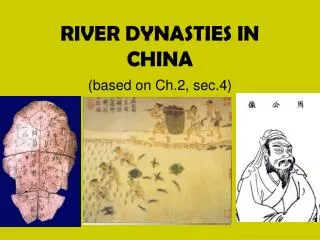
Religious Beliefs • Spirits of dead ancestors can affect family fortunes • Priests scratch questions on animal bones and tortoise shells • Oracle bones used to consult gods; supreme god, Shang Di • Development of Writing • Writing system uses symbols to represent syllables; not ideas • People of different languages can use same system • Huge number of characters make system difficult to learn
Zhou and the Dynastic Cycle • Mandate of Heaven • Mandate of Heaven—the belief that a just ruler had divine approval • Developed as justification for change in power to Zhou • Dynastic cycle—pattern of the rise and decline of dynasties
Strong Dynasty establishes peace and prosperity; it is said to have the Mandate of Heaven. New dynasty gains power, restores peace and order, and claims to have Mandate of Heaven. In time, the dynasty declines and becomes corrupt; taxes are raised; power weakens. Dynastic Cycle in China Dynasty is overthrown through rebellion and bloodshed; new dynasty emerges. Disasters such as floods, famines, peasant revolts, and invasions occur. Old dynasty is seen as losing Mandate of Heaven; rebellion is justified.
Control Through Feudalism • Feudalism—system where kings give land to nobles in exchange for services • Over time, nobles grow in power and begin to fight each other • Improvements in Technology and Trade • Zhou Dynasty builds roads, canals to improve transportation • Uses coins to make trade easier • Produces cast iron tools and weapons; food production increases • A Period of Warring States • Peaceful, stable Zhou empire rules from around 1027 to 256 B.C. • In 771 B.C., nomads sack the Zhou capital, murder monarch • Luoyang becomes new capital; but internal wars destroy traditions