Download
1 / 58
610 likes | 754 Views
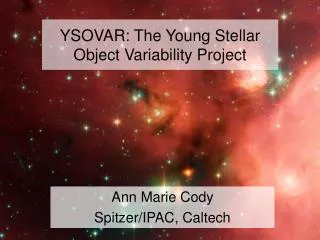
The Young Stellar Object Variability Project (YSOVAR) aims to uncover the dynamic behavior of young stars through extensive photometric monitoring, focusing on stellar and disk interactions. With over 500 hours of Spitzer time, YSOVAR has observed approximately 2,000 young stellar objects in regions like the Orion Nebula and NGC 2264. This project provides groundbreaking insights into stellar rotational periods, variability patterns, and the correlation between young stars and their surrounding disk structures, deepening our understanding of star formation and evolution.

E N D
YSOVAR: The Young Stellar Object Variability Project Ann Marie Cody Spitzer/IPAC, Caltech
YSOVAR: “WHY-SO-VARiable?” Ann Marie Cody Spitzer/IPAC, Caltech
Thanks to many collaborators… John Stauffer (P.I.), Maria Morales-Calderón At Caltech, JPL & LA: Luisa Rebull, Lynne Hillenbrand, John Carpenter, Peter Plavchan, Krzysztof Findeisen, Neal Turner, Susan Terebey And many other institutions: The YSOVAR team: ysovar.ipac.caltech.edu
outline • Motivation: Why do yet another photometric monitoring • campaign? • What is YSOVAR? • First results from YSOVAR • A brief foray into NGC 2264
outline • Motivation: Why do yet another photometric monitoring • campaign? • What is YSOVAR? • First results from YSOVAR • A brief foray into NGC 2264
Static, symmetric picture Hartmann 1999
Young stars are dynamic! HH30: HST/WFPC2 @ ~1 frame per year disk diameter ~ 450 AU Light beam P~7.5d (Duran-Rojas et al. 2009; Watson & Stapelfeldt 2007)
We can learn about dynamics through time series photometry 80 days 80 days Periodic- Stassun et al. 1999 Aperiodic- Frasca et al. (2010)
2003-2013: A revolution in space based Monitoring of young stars Spitzer CoRoT MOST ? Alencar et al. (2010) Optical infrared Morales-Calderón et al. (2009)
outline • Motivation: Why do yet another photometric monitoring • campaign? • What is YSOVAR? • First results from YSOVAR • A brief foray into NGC 2264
Ysovar in a nutshell • GO-6 Exploration Science program >500 hrs of Spitzer time • Time series photometric monitoring at 3.6 and 4.5 um • Includes ~1 square degree of the ONC plus 11 other well-known SFRs • Typically ~100 epochs/region (sampled ~2x/day for 40d, less frequently at longer timescales) • A couple thousand YSOs with good light curves! • Data taken over the period Sep 2009 -- June 2011
Ysovar in a nutshell Time series YSOVAR
Ysovar clusters • L1688 • Serpens Main • Serpens South • IRAS 20050+2070 • IC1396 • Ceph-C • AFGL 490 • NCG 1333 • Orion • Mon R2 • GGD 12-15 • NGC 2264
Ysovar/Orion spitzer data • ~250 hours of observing time • ~ 1 square degree region of the Orion Nebula cluster • Cadence: 40 days, with ∼2 epochs each day. • ~1400 Class I and II Orion YSOs with good quality time series (1-2% accuracy)
Ysovar/Orion Ground-based data • Near-IR: • CFHT/WIRCAM: 10 nights. J & Ks • UKIRT/WFCAM: ~30 epochs over 60 nights. J • 2.1m KPNO/FLAMINGOS: 10 nights. JHKs • CTIO 1.3/ANDICAM: ~30 epochs over 60 nights. J & I • PAIRITEL: ~20 epochs over 35 nights. JHKs • CAIN/TCS: 15 nights. J & Ks • Optical: • USNO/Flagstaff: 7 nights. I band • LOWELL/21”: 22 nights. I band • NMSU-APO/40”: 24 nights. VI bands • LCOGT/FTEM: 17 nights. I band. • KPNO 24”/Slotis: 27 nights. I band • CAHA 1.23m: 30 nights. BVI • Arcsat APO, 0.5m: 5 nights. I band
Ysovar science goals • Provide empirical constraints on physical processes and structures characterizing the interaction between the star, inner disk/envelope and accretion flows. • Make unique measurements of the rotational periods of the most embedded, youngest protostars • Place constraints on the long-term variability of YSOs at IRAC wavelengths. • Discover new eclipsing binary systems to provide benchmarks for young, low-mass evolution tracks
Light curve acquisition Morphological classification Search for correlations with stellar/disk parameters • Rotational evolution • Disk structure • Magnetospheric accretion Comparison with models
outline • Motivation: Why do yet another photometric monitoring • campaign? • What is YSOVAR? • First results from YSOVAR • A brief foray into NGC 2264
First results An enormous variety of light curves!
Ysovar/Orion Variability examples Spitzer light curves: 3.6 and 4.5 μm Morales-Calderón et al. (2011)
Ysovar/Orion Variability examples Combined Spitzer and ground-based light curves Morales-Calderón et al. (2011)
Ysovar/Orion Variability census 70% of disk bearing stars are variable in the IRAC bands
Light curve acquisition Morphological classification Search for correlations with stellar/disk parameters • Rotational evolution • Disk structure • Magnetospheric accretion Comparison with models
Periodic stars • Can get a period for just 16% of the variable Class I+IIs (90% of those are Class IIs, 10% are Class Is.) mostly seeing disks here • For members w/o IR excess, 30% are variables, mostly periodic photosphere • 30% of sample had literature period; 35% of those are recovered, just 18% of those with IR excess (thermal dust emission on top of stellar signal). • 137 new periods.
Periodic stars Tests of disk locking YSOVAR: everything but Orion YSOVAR: everything including Orion Disk bearing Bare photospheres courtesy L. Rebull
6 new eclipsing binaries in orion ISOY J0535- 0447 P=3.906d M1=0.83 M1=0.05 SpTs: K0,K2 θ1Ori E M1=2.807 M2=2.797 SpTs: M5,M6 Morales-Calderón et al. (2012)
“dippers”: Aa tau analogs • 41 examples in the Orion data. • Flux dips ~0.1-0.4 mag IRAC • up to >1 mag at I and J • <3 days duration • Usually one or two dips in 40 days • Extincting bodies?
Questions about dippers • Disk must be seen at relatively high (and relatively narrow range of) inclinations to do this, so expect that they are rare. • YSOVAR Orion (year 1): Morales-Calderon et al. (2011) finds overall fraction likely ~5% (2011). • First CoRoT short run (2008) on NGC2264: Alencar et al. (2010) finds overall fraction likely ~30%. • What’s going on? Different ages of stars (Orion vs. NGC 2264)? Different wavelengths (optical vs. IR)? Different cadences? (Different definitions of the category?)
Large amplitude infrared behavior • No variations at shorter wavelengths. • Warped disks? [4.5] I [3.6] J
outline • Motivation: Why do yet another photometric monitoring • campaign? • What is YSOVAR? • First results from YSOVAR • A brief foray into NGC 2264
Ysovar’s successor: the CoordinatedSynoptic Investigation of NGC 2264 • Spitzer: 30 days, 3.6-4.5 μm • CoRoT: 40 days, optical • Chandra/ACIS: 300ks (3.5 days) • MOST: 40 days, optical • VLT/Flames: ~20 epochs • Ground-based monitoring • U-K bands: ~3 months
CSI results: many pairs of optical and irlightcurves are uncorrelated! Magnitude [4.5] CoRoTSpitzer Time (days) Magnitude [4.5] CoRoTSpitzer 40 days
CSI results: optical/ir phase lags are rare CoRoTSpitzer
At least 10% of disk-bearing stars show High-amplitude behavior in the ir only Magnitude [4.5] CoRoTSpitzer Magnitude [4.5] Time (days)
High inclination: Quasi-periodic flux dips caused by disk blobs or warps CoRoTSpitzer Magnitude [4.5] Time (days)
Corot data reveals Flux events that may be accretion bursts • These objects have preferentially high UV excesses and • Hα emission indicative of strong accretion.
Light curve acquisition Disk-bearing stars Periodic, AA Tau ~11% Aperiodic, stochastic ~26% Periodic, sinusoidal ~3% Aperiodic, dipper ~13% Non-variable optical/ variable IR ~10% Non-variable ~17% Periodic, non-sinusoidal ~12% Aperiodic, burster ~11% Search for correlations with stellar/disk parameters Comparison with models
An approach to classification Flux Asymmetry Bursters Stochasticity Purely periodic Quasi-periodic stars Stochastic stars Eclipsing binaries Dippers
classes can now be selected statistically! Cody, Stauffer, in prep.
Summary and future plans • We have performed a periodic variability census in the Orion dataset; • complete classification and understanding of aperiodic behavior remains • Among the prominent variability types are “dippers” and high • amplitude infrared behavior…along with 6 new eclipsing binaries • We find evidence for disk locking in all clusters • We have just finished a complete morphological classification of • variability in NGC 2264 with CoRoT and Spitzer; we will now go back • to Orion and apply this framework • Follow-up of interesting variables is upcoming; the long time baseline • available is another direction to pursue • Stay tuned for further results from the full set of YSOVAR clusters • and the CSI project
First data release You can download YSOVAR Orion data from: http://ysovar.ipac.caltech.edu/first_data_release.html http://cosmos.physast.uga.edu/Public/
Inner rim scale height changes Ke et al. (2012)
VJ3.6 60o 0.8 AU No magnetic support Neal Turner, JPL
VJ3.6 60o 0.8 AU Magnetic support near 0.1 AU
… Enter csi 2264 CoRoTSpitzer Magnitude [4.5] Time (days) CoRoTSpitzer Magnitude [4.5] 40 days
Fading events become deeper in the infrared as we go to lower mass… CoRoT Spitzer