Vibrations and Waves
This article explores the fundamental concepts of vibrations and waves, focusing on Hooke’s Law, elastic potential energy, and simple harmonic motion (SHM). It discusses how the force of a spring influences the motion of an object, resulting in oscillation defined by amplitude and period. Additionally, it highlights the relationship between frequency and period, as well as energy conservation in SHM, relating maximum energy points in motion to circular motion. Key equations and diagrams provide a comprehensive understanding of the subject.

Vibrations and Waves
E N D
Presentation Transcript
Vibrations and Waves Hooke’s Law Elastic Potential Energy Simple Harmonic Motion
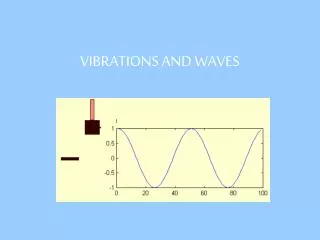
Springs • _________ force of spring pushes/pulls mass toward ___________ • Results in simple _______ motion • Newton’s 2nd Law gives harmonic _______ equation Fig. 13.1, p. 426
Describing SHM • Amplitude, A, is _________ displacement from ________. Object oscillates between x = +A and x = −A • Period, T, is the time required to move through one complete ______ • Frequency, f, is the number of complete cycles per unit _____. f = 1/T
Elastic Potential Energy • Recall energy ______ in spring • Apply _____-_______ theorem Fig. 13.4, p. 429
Velocity as a Function of Position • Energy at maximum ___________ equals energy at ___ point in cycle Fig. 13.7, p. 431
SHM and Uniform Circular Motion • The projection of a ball rotating with constant angular speed, , on a two dimensional surface moves with simple harmonic motion Figs. 13.8 & 13.9, p. 433
SHM and Uniform Circular Motion • Equate energy at maximum __________ to energy at _________ position • Substitute into expression for period