Nervous System
80 likes | 198 Views
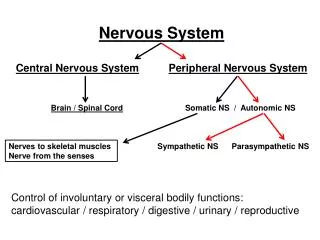
The nervous system is a complex network crucial for communication within the body. It comprises the central nervous system (CNS), including the brain and spinal cord, and the peripheral nervous system (PNS), which connects the CNS to the rest of the body via cranial and spinal nerves. The PNS has sensory (afferent) and motor (efferent) divisions. Reflex arcs facilitate rapid responses to stimuli, maintaining homeostasis. This overview highlights the structure, functionality, and significance of various components of the nervous system.


Nervous System
E N D
Presentation Transcript
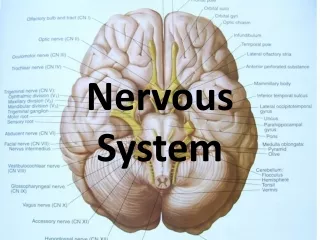
Nervous System …the brain…
Nervous System …the brain…
Nervous System …the brain…
Nervous System …the brain…
Nervous System Peripheral Nervous System
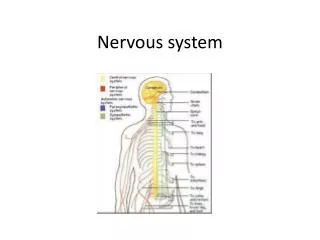
Nerve fibres carrying msgs to/from CNS & groups of nerve cell bodies (ganglion) Nervous System Cranial Nerves: 12 pairs of nerves arising from brain (eg optic nerve, auditory nerve) most mixed, some single. Spinal Nerves: 31 pairs of mixed nerves each joined to the spinal cord by two roots. Peripheral Nervous System 1. Ventral Root: axons of motor neurons with cell bodies in grey matter of spinal cord 2. Dorsal Root: axons of sensory neurons with cell bodies in small swelling on dorsal root (dorsal root ganglion)
Divisions: Afferent (sensory) Division: Nervous System Efferent (motor) Division: Somatic (voluntary) Division: Autonomic (involuntary) Division: Peripheral Nervous System Sympathetic (preparation) Division: Parasympathetic (maintenance) Division:
Reflex is a rapid, automatic response to a change in the internal / external environment (homeostasis) Nervous System Reflex Arc or Spinal reflex arc: Receptor: Sensory Neuron: Spinal reflexes Synapse: Motor Neuron: Effector: